



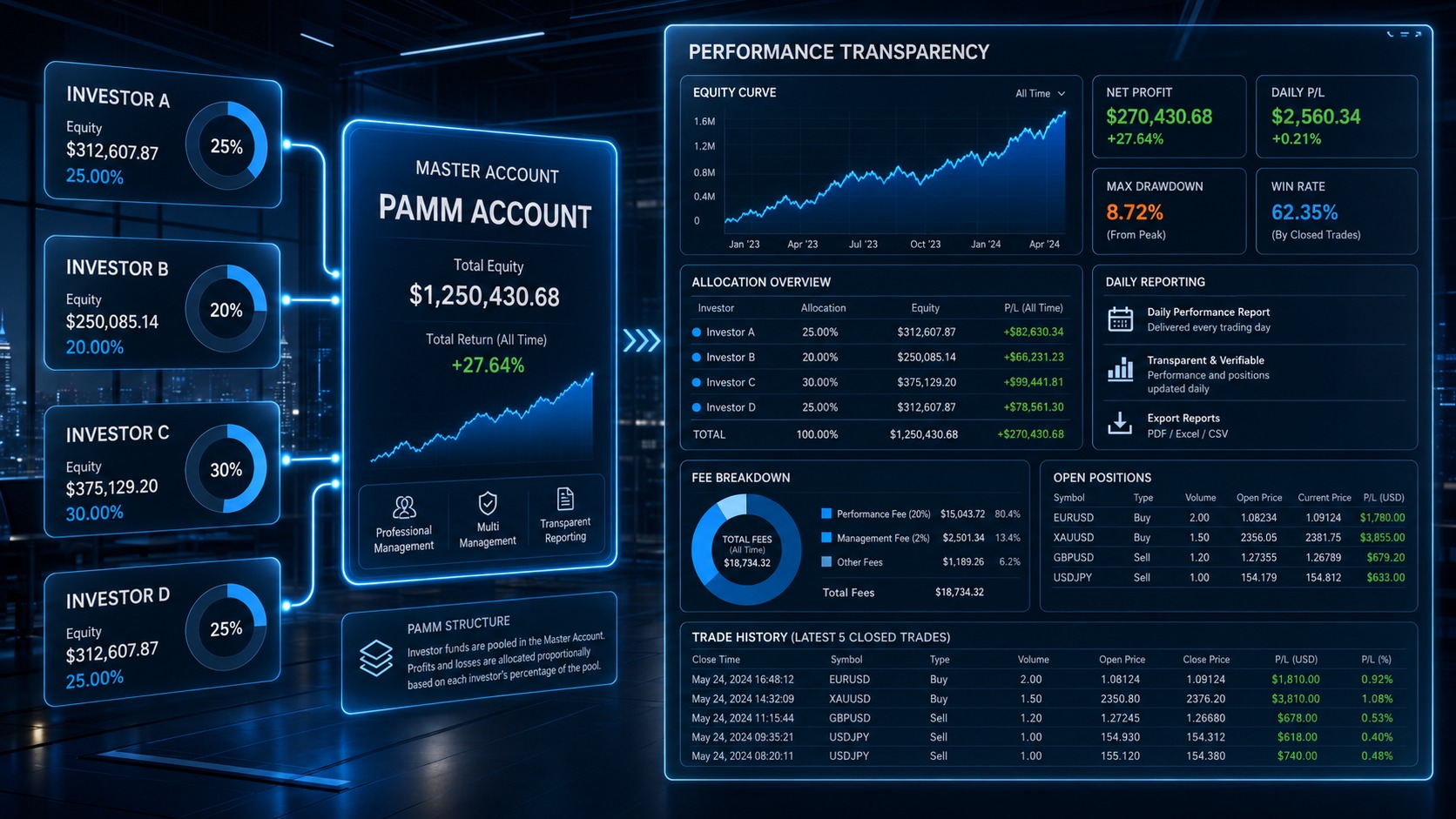
What Is a PAMM Account
A PAMM account, short for Percentage Allocation Management Module, allows a money manager to trade on behalf of multiple investors from a single pooled account, with profits and losses allocated proportionally based on each investor’s contribution. It is a structure that has been used across the forex industry for years as a way to give investors exposure to a manager’s strategy without needing to place trades themselves.
The structure only works well, however, when investors can trust the numbers behind it. Without independent verification, an investor is left relying entirely on a manager’s own reporting, which is a difficult position for anyone doing real due diligence before allocating capital.
PAMM structures have remained popular precisely because they solve a real problem: not every trader has the time, temperament, or experience to manage a strategy actively, but many still want market exposure tied to a demonstrated approach. The structure only delivers on that promise, however, if the reporting behind it can actually be trusted.
Why Independent Verification Matters
This is where third-party tracking tools become important. Independent performance-tracking services pull data directly from a trading account and publish it in a format that cannot be selectively edited by the manager whose performance is being shown. That distinction, data reported by the account itself rather than summarized after the fact, is what separates a verifiable track record from a simple claim.
- Performance data pulled directly from the trading account, not self-reported
- A historical record that reflects both gains and losses over time
- A consistent, independent format that makes comparison across strategies easier
This is a meaningful distinction in an industry where performance claims are, unfortunately, easy to overstate. A manager summarizing their own results has an obvious incentive to present the most favorable picture possible. A platform pulling data directly from the trading account has no such incentive, which is exactly why independent tracking has become the standard that serious investors look for before allocating capital.
How OTOFX Tracks PAMM Performance Through FX Blue and Myfxbook
OTOFX’s PAMM accounts are tracked using FX Blue and Myfxbook, two widely used independent platforms in the forex industry that generate live, verifiable statistics directly from a trading account. Rather than asking investors to take a manager’s performance summary at face value, OTOFX’s PAMM structure is built around this kind of third-party verification as a standard part of the offering.
For an industry where trust is difficult to earn and easy to lose, tying PAMM performance to established, independent tracking tools is a meaningful design choice. It signals that the underlying data is meant to be checked, not just presented.
Reading a Verified Track Record
Independent tracking platforms like FX Blue and Myfxbook typically display a range of statistics beyond headline returns, including drawdown history, trade frequency, and risk metrics. Investors evaluating a PAMM strategy should look at this fuller picture rather than focusing solely on total return, since two strategies with similar headline numbers can carry very different risk profiles.
OTOFX’s PAMM accounts are structured around this kind of transparent reporting, giving investors a consistent, independently verified reference point regardless of which strategy they are evaluating.
PAMM Accounts and Risk: What Independent Data Reveals
One of the most useful things independent tracking makes possible is a clear-eyed look at risk, not just returns. Drawdown figures, which show the largest peak-to-trough decline in an account’s value, are often more informative than headline gains when evaluating whether a strategy matches an investor’s own risk tolerance.
Because platforms like FX Blue and Myfxbook calculate these figures directly from account activity, investors do not have to rely on a manager’s own characterization of their risk profile. This is particularly valuable for investors comparing multiple PAMM strategies at once, since consistent, independently calculated metrics make an apples-to-apples comparison possible in a way that self-reported summaries rarely allow.
What This Means for Money Managers
For money managers operating within OTOFX’s PAMM structure, independent tracking is also an advantage. A verifiable track record, built up over time on a platform that investors already recognize and trust, is a far more persuasive credential than a self-published summary. It shifts the conversation from “trust me” to “here is the data,” which tends to matter a great deal to investors evaluating multiple strategies at once.
It also raises the bar across the board. When investors have easy access to independently verified data, managers competing for allocation have a strong incentive to build genuinely consistent track records rather than relying on selective reporting or short-term results. Over time, that dynamic tends to favor managers with a demonstrated, verifiable process.
What This Means for Investors Following a Strategy
For investors, the practical benefit is straightforward: performance figures can be reviewed independently, over whatever time period is relevant, rather than accepted on the manager’s word. That does not remove the underlying risk of allocating capital to any trading strategy, but it does remove a layer of uncertainty about whether the numbers being shown are accurate in the first place.
Investors are still encouraged to review a manager’s full historical performance, including drawdown periods, rather than focusing only on headline gains, since a complete picture is always more useful than a partial one.
Transparency as a Foundation, Not an Afterthought
Structuring PAMM accounts around FX Blue and Myfxbook reflects a broader pattern in how OTOFX has approached its account offering: building verification into the structure itself rather than treating it as an optional extra. For traders and investors weighing where to place capital, that kind of built-in transparency is worth factoring into the decision.
Frequently Asked Questions
What’s the difference between a PAMM account and copy trading?
Both allow investors to follow another trader’s strategy, but PAMM structures typically pool capital into a single managed account with proportional allocation, while copy trading mirrors trades individually across separate accounts. The two are related but structurally different.
Why use FX Blue and Myfxbook instead of a broker’s own reporting?
Because the data is pulled directly from the trading account by an independent third party, rather than summarized internally, which reduces the risk of selective or inaccurate reporting.
Does independent verification guarantee future performance?
No. Verification confirms that historical data is accurate; it does not predict future results. Past performance, verified or not, is never a guarantee of what will happen going forward.
How can investors review a manager’s full history, not just recent results?
FX Blue and Myfxbook both typically allow viewing of historical performance over extended periods, which is available for PAMM accounts offered through OTOFX.
What should investors look at besides total return?
Drawdown history, consistency over time, and how a strategy has performed across different market conditions are all more informative than a single headline return figure, and all are visible through independent tracking platforms.