



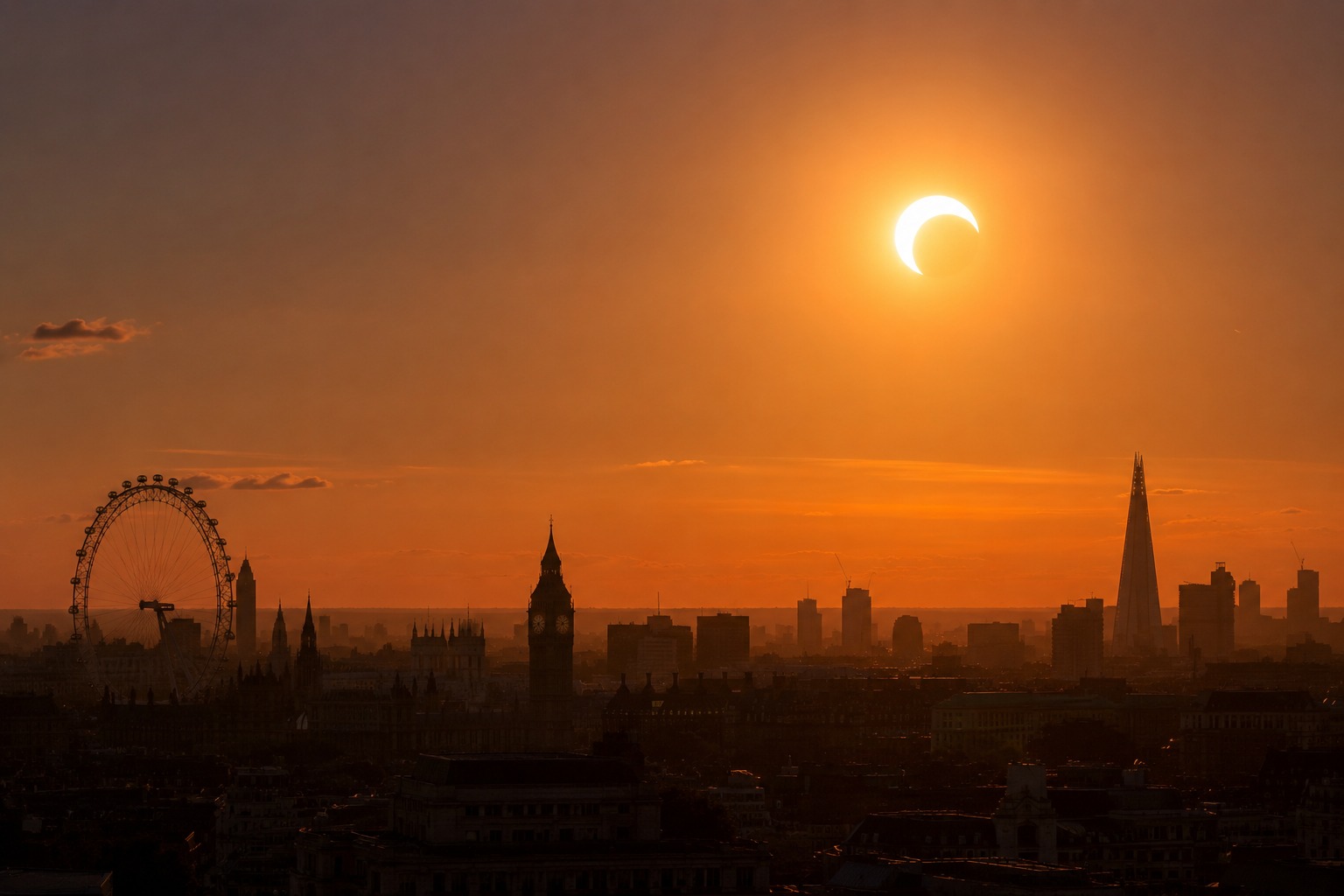
London is about to get one of its most dramatic views of the Sun in decades. On Wednesday 12 August 2026, the Moon will pass across the Sun and create a deep partial solar eclipse over the capital. It will not become fully dark, and London is outside the path of totality, but at the peak roughly 90% of the Sun will be covered.
The timing makes this eclipse especially striking. It begins in the early evening and develops as the Sun drops towards the western horizon, so the event should feel less like a midday science demonstration and more like a very unusual summer sunset. For anyone planning to watch from London, the two things that matter most are finding an open view to the west and using proper solar eye protection.
You do not need specialist astronomy knowledge to enjoy it. You do, however, need to know the timings, what to expect, and what not to use when looking at the Sun.
| Quick Answer: What time is the solar eclipse in London? The partial solar eclipse in London begins at about 6:17 pm on Wednesday 12 August 2026, reaches maximum coverage at about 7:12 pm, and ends at about 8:06 pm. Around 90% of the Sun will be covered at maximum. London will see a partial eclipse, not totality. Use certified eclipse glasses or an indirect viewing method; ordinary sunglasses are not safe. |
Solar eclipse London timings for 12 August 2026
The event lasts for just under two hours in London. The important times are:
Around 6:17 pm: The partial eclipse begins as the Moon first starts to move across the Sun.
Around 7:12 pm: Maximum eclipse. About 90% of the Sun will be covered from London.
Around 8:06 pm: The Moon moves clear of the Sun and the partial eclipse ends.
The exact minute can vary slightly depending on where you are in Greater London, but the difference is small. The main viewing window is therefore the hour around maximum eclipse, particularly from about 6:45pm onwards.
What will the eclipse look like from London?
At first, the change will be subtle. A small dark curve will appear to take a bite from the Sun. Over the next hour that curve will grow until only a bright crescent of the Sun remains uncovered.
Because this is a partial eclipse, London will not experience the sudden darkness associated with totality. Even a thin uncovered section of the Sun remains extremely bright. Around the maximum, though, daylight should become noticeably flatter and dimmer, and the temperature may feel slightly cooler. Shadows can also look sharper or stranger than usual.
One of the easiest eclipse effects to notice does not require looking at the Sun at all. If you stand near a leafy tree, the tiny gaps between leaves can act like natural pinhole projectors, scattering small crescent-shaped images of the eclipsed Sun across the ground.
Why the August 2026 eclipse is a big event for the UK
For the UK and Ireland, this is the deepest solar eclipse seen since 1999. Coverage varies by location, with the south-west seeing more of the Sun obscured than London, but the capital still gets an unusually strong partial eclipse at roughly 90%.
The path of totality runs elsewhere, including parts of Greenland, Iceland and northern Spain. That means travellers inside that narrow path can see the Sun completely covered for a short period. Londoners will not see the corona or a true total-eclipse blackout, but the amount of solar coverage is still large enough to make the event memorable.
It is also unusually accessible: there is no need to wake before dawn or travel far outside the city. The eclipse unfolds during the early evening, when many people will already be finishing work or heading out.
Where should you watch the solar eclipse in London?
The best location is not necessarily the highest building. What matters most is a clear, unobstructed view towards the western horizon because the Sun will be getting lower as the eclipse progresses.
Greenwich is an obvious choice for astronomy fans. The area combines open parkland with London’s long astronomical history. If you are making an afternoon of it, FEAST’s guide to Greenwich and other London hidden gems is useful for ideas nearby before the eclipse begins.
Large parks and open spaces can work well. The key is to avoid trees, towers or buildings blocking the western sky. If you want to combine the eclipse with a low-cost day in the capital, FEAST’s 23 free things to do in London includes several outdoor and Greenwich-based stops that can help shape the rest of the day.
Wherever you go, arrive early enough to check the horizon before the eclipse starts. A place that looks open at 5 pm may still lose the Sun behind a line of buildings once it drops lower. Avoid stepping onto roads, railway edges, restricted rooftops, or other unsafe locations just to improve the view.
How to watch the eclipse safely
This is the part that cannot be improvised. Looking directly at the Sun can permanently damage your eyes, and a partial eclipse does not make normal sunlight safe to stare at.
Use proper eclipse glasses. They should be designed specifically for direct solar viewing and carry the ISO 12312-2 safety standard. Regular sunglasses, no matter how dark they are, are not enough.
Do not use an ordinary telescope, camera lens or binoculars to look at the Sun. Optical equipment concentrates sunlight and can cause severe injury. A telescope is only suitable when it has the correct specialist solar filter fitted and is being used as intended.
Try indirect projection if you do not have eclipse glasses. A simple pinhole projector lets you watch the changing shape of the Sun without looking directly at it. A colander can produce the same effect by projecting many small crescent images onto the ground or a sheet of paper.
For official viewing advice and London event information, check the Royal Observatory Greenwich guide to the 12 August 2026 partial solar eclipse. The Observatory is also offering a live stream for people who cannot get a clear view outside.
Can you photograph the solar eclipse with your phone?
You can photograph an eclipse, but pointing a camera directly at the Sun is not something to treat casually. The safest approach for most casual viewers is to concentrate on the atmosphere around the event: the changing light, crescent projections on the ground, silhouettes and the crowd watching safely.
If you want a close image of the Sun itself, use equipment designed for solar photography and follow the manufacturer’s instructions. Do not hold eclipse glasses in front of a telescope or binoculars as a makeshift filter. Solar filters for magnifying optics are designed to sit in the correct position and handle concentrated sunlight safely.
For many people, a wide photo of London under the strange evening light will make a better memory than a tiny overexposed Sun in the centre of a phone screen anyway.
What happens if London is cloudy?
Cloud is the one part of the eclipse nobody can schedule. A thin layer can sometimes still allow the changing light to be noticed, but thick cloud may hide the Sun completely.
Avoid chasing gaps in the cloud around the city at the last minute. Instead, check the forecast and satellite cloud cover earlier in the day, choose a location with a good western horizon, and have a live stream ready as a backup. Even if the Sun disappears at maximum eclipse, the wider change in daylight may still be noticeable.
The timing also means patience matters. Conditions can change quickly during a nearly two-hour event, so one cloudy moment at the beginning does not automatically mean the whole eclipse is lost.
If the eclipse gets you interested in astronomy
Solar observing is a specialist activity, but the eclipse may be the thing that gets you looking up more often. For ordinary night-sky observing, FEAST’s guide to stargazing on a budget explains the basics of choosing an affordable telescope. Remember that equipment intended for night-time stargazing must never be pointed at the Sun unless it has a purpose-built solar filter and is being used correctly.
Frequently asked questions
Is there a solar eclipse in London on 12 August 2026?
Yes. London will see a deep partial solar eclipse on Wednesday 12 August 2026. The total phase is not visible from London.
What time is the solar eclipse in London?
The partial eclipse begins at about 6:17 pm, reaches maximum at about 7:12 pm and ends at about 8:06 pm.
How much of the Sun will be covered in London?
Around 90% of the Sun will be covered by the Moon at maximum eclipse from London.
Will it go dark in London during the eclipse?
No. London is outside the path of totality. Light levels should drop noticeably, but the sky will not become completely dark.
Can I watch the eclipse through sunglasses?
No. Ordinary sunglasses are not safe for direct solar viewing. Use certified eclipse glasses or an indirect projection method.
Which direction should I look?
The eclipse takes place as the Sun is moving towards sunset, so a clear view towards the western horizon is important.
A rare London evening worth planning for
The 12 August eclipse is the kind of event that rewards a small amount of preparation. Know the three key times, choose somewhere with an open western view and sort out safe viewing equipment before the afternoon begins.
You do not need to leave London to see a striking eclipse. At maximum, only a narrow part of the Sun will remain uncovered, giving the capital one of its best solar-eclipse views in a generation. If the weather cooperates, 7:12 pm is the moment to have your eyes safely on the sky.