



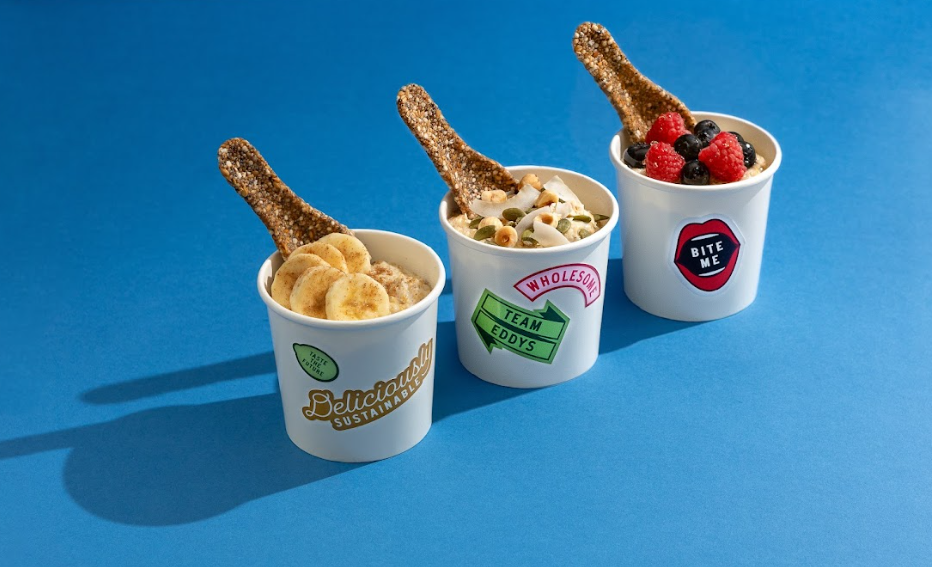
A playful collision of indulgence and sustainability is arriving in King’s Cross this spring, as The After School Cookie Club prepares to introduce an unusual — and entirely edible — addition to its menu. From 28 March, the bakery brand will launch eddy’s edible spoons at its Coal Drops Yard site, marking the start of the wider Super Nature 2026 celebrations.
The initiative builds on a successful earlier trial at the brand’s Mayfair location, where demand for the spoons reportedly exceeded expectations. Now, customers in King’s Cross will be able to experience the concept firsthand, with the spoons served exclusively alongside a limited-edition apple crumble pot created to complement their flavour and texture.
At first glance, the idea of eating your cutlery may feel novel, even whimsical. Yet behind the concept lies a serious commitment to reducing waste. Eddy’s spoons are made from a blend of five grains and seeds, designed not only to hold their structure when used with hot or cold desserts, but also to offer a subtly nutty flavour profile. The result is a product that sits somewhere between a biscuit and a cracker — sturdy enough to function as a spoon, but enjoyable enough to eat afterwards.
For The After School Cookie Club, the partnership reflects a broader ambition to rethink how sweet treats are served and consumed. The brand has been quietly positioning itself at the intersection of comfort food and environmental responsibility, working with carbon tracking platforms and introducing internal benchmarking measures to reduce its overall footprint. Its stated aim is ambitious: to become the UK’s lowest carbon sweet treat brand.
Launching the edible spoons in King’s Cross is a strategic move in that journey. The area has rapidly evolved into one of London’s most forward-thinking food destinations, with Coal Drops Yard and Granary Square drawing a mix of office workers, creatives and visitors seeking both quality and innovation. It is also the central stage for Super Nature, an annual programme dedicated to sustainability and circular thinking.
Super Nature 2026 will bring a series of installations, art activations and public discussions to the district, all centred on encouraging more environmentally conscious behaviours. From rethinking daily commutes to extending the lifespan of clothing and reducing single-use materials, the initiative aims to make sustainability both visible and accessible.
Food plays a key role in that conversation. By integrating edible cutlery into its offering, The After School Cookie Club is participating in a wider effort to challenge привычные habits around consumption and waste. Unlike compostable or recyclable alternatives, which still require infrastructure and behavioural follow-through, edible spoons eliminate the question of disposal entirely.
“There’s something disarmingly simple about it,” says one industry observer. “You don’t need to think about where it goes afterwards — because there is no ‘afterwards’. It becomes part of the experience.”
The apple crumble pot, developed specifically for the launch, leans into that idea of experience-led sustainability. Warm, nostalgic and inherently British, the dessert pairs naturally with the grain-based spoon, creating a cohesive product rather than a gimmick. It also reinforces the brand’s focus on comfort-driven treats, albeit with a modern, environmentally aware twist.
Importantly, the initiative does not position sustainability as a sacrifice. The emphasis remains firmly on taste and enjoyment — “delicious first and sustainable always,” as the company puts it. This approach reflects a broader shift within the food industry, where consumers are increasingly unwilling to compromise on flavour, even as they seek more responsible options.
King’s Cross, with its blend of innovation and footfall, offers the ideal testing ground. The working community that passes through the area daily provides a ready audience for ideas that are both practical and progressive. By situating the launch within the Super Nature programme, the brand also benefits from a wider cultural context that amplifies its message.
For now, the edible spoons will remain exclusive to the King’s Cross site, adding a sense of occasion — and perhaps a hint of urgency — for those keen to try them. Whether they signal a broader shift in how food is served remains to be seen. But as sustainability continues to move from niche concern to mainstream expectation, it is precisely these kinds of small, tangible innovations that may leave the most lasting impression.
Or, in this case, no trace at all.