


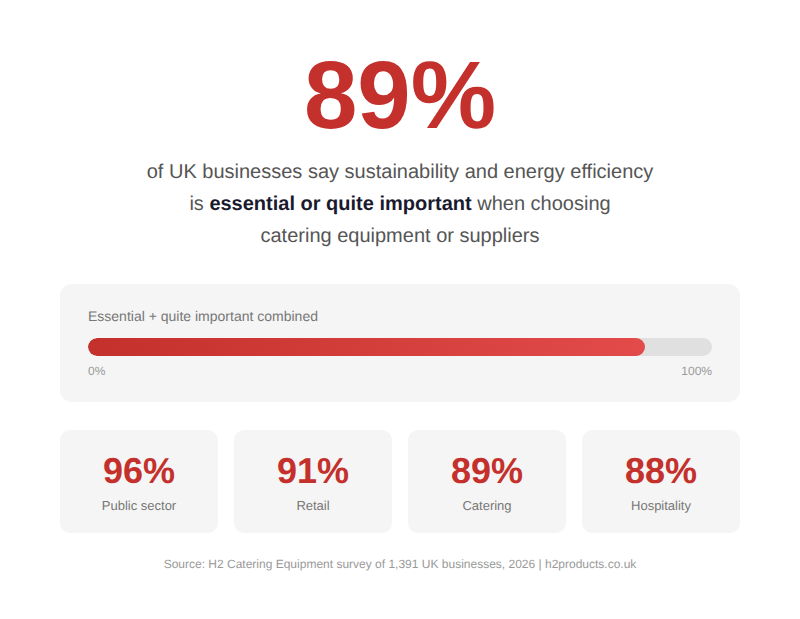
Research conducted across 1,391 UK businesses has established that sustainability and energy efficiency have become central considerations in catering equipment procurement, with 89% of firms surveyed rating these factors as either “essential” or “quite important” when choosing new equipment or suppliers.
Responses were collected from decision-makers working across the hospitality, retail, catering, and public sectors, and the results indicate a marked change in the criteria that buyers apply when equipping their kitchens, bars, and operational spaces.
The survey posed a single focused question to all participants: “When choosing new catering equipment or suppliers, how important are sustainability and energy efficiency?”
Public sector organisations demonstrated the strongest commitment to sustainability of any group in the survey, with 96.4% rating it as essential or quite important. Notably, no respondent from the public sector indicated that sustainability held no importance at all in their decision-making. This pattern reflects the obligations placed on suppliers under government procurement policy note PPN 06/21, which requires those bidding for large public sector contracts to show that they have credible plans in place to reduce their carbon output.
Sustainability also featured prominently in the retail sector, where 90.8% of businesses ranked it highly in their procurement considerations, including 40.5% who described it as essential. The catering sector recorded 88.7%, whilst the hospitality sector, representing the largest single group with 574 businesses taking part, came in at 88.0%.
Across all respondents, only 1.4% stated that sustainability carried no weight at all when making purchasing decisions.
The survey results come against the backdrop of ongoing pressure from energy costs across the sector. According to figures published by the Carbon Trust, businesses in the hospitality sector alone spend more than £1.3 billion on energy each year and are responsible for over eight million tonnes of carbon emissions annually. The sector is also known to use up to ten times the energy per square metre that a typical commercial property consumes.
Concurrent changes to the tax system are providing businesses with additional financial reasons to upgrade their equipment. Since January 2026, unincorporated businesses and landlords have had access to a new 40% first-year capital allowance applicable to qualifying energy-efficient catering equipment, while incorporated businesses continue to be able to claim 100% first-year write-offs through permanent full expensing. The combined effect of these allowances is to cut the real cost of switching to more efficient equipment by up to a quarter.
Dale Howard, Director at H2 Catering Equipment said: “This data backs up what we’re hearing from customers every day. Businesses aren’t choosing energy-efficient catering equipment to tick a box. They’re doing it because their margins depend on it. When nine out of ten firms tell you sustainability is a priority, that’s not a trend. That’s just the way things work now.
“The results should be a wake-up call for catering equipment manufacturers, distributors, and suppliers across the UK. With nearly nine in ten businesses actively weighing sustainability in their procurement decisions, companies that cannot demonstrate verifiable energy efficiency credentials risk being left off shortlists altogether.”
According to Dale, the survey data also shines a light on an expanding opportunity in the public sector, where increasing obligations to report on Scope 2 and Scope 3 emissions are driving procurement teams to request detailed carbon information from their suppliers, right down to individual product level.
He added: “Manufacturers who can provide transparent energy ratings, lifecycle cost analyses, and embodied carbon data stand to win more of these contracts.
“The question buyers are asking has changed. It used to be ‘does it save energy?’ Now it’s ‘can you prove it?’ They want data, not promises. The businesses that do well from here will be the ones treating energy performance as a core product spec, not something they bolt on at the end.”