



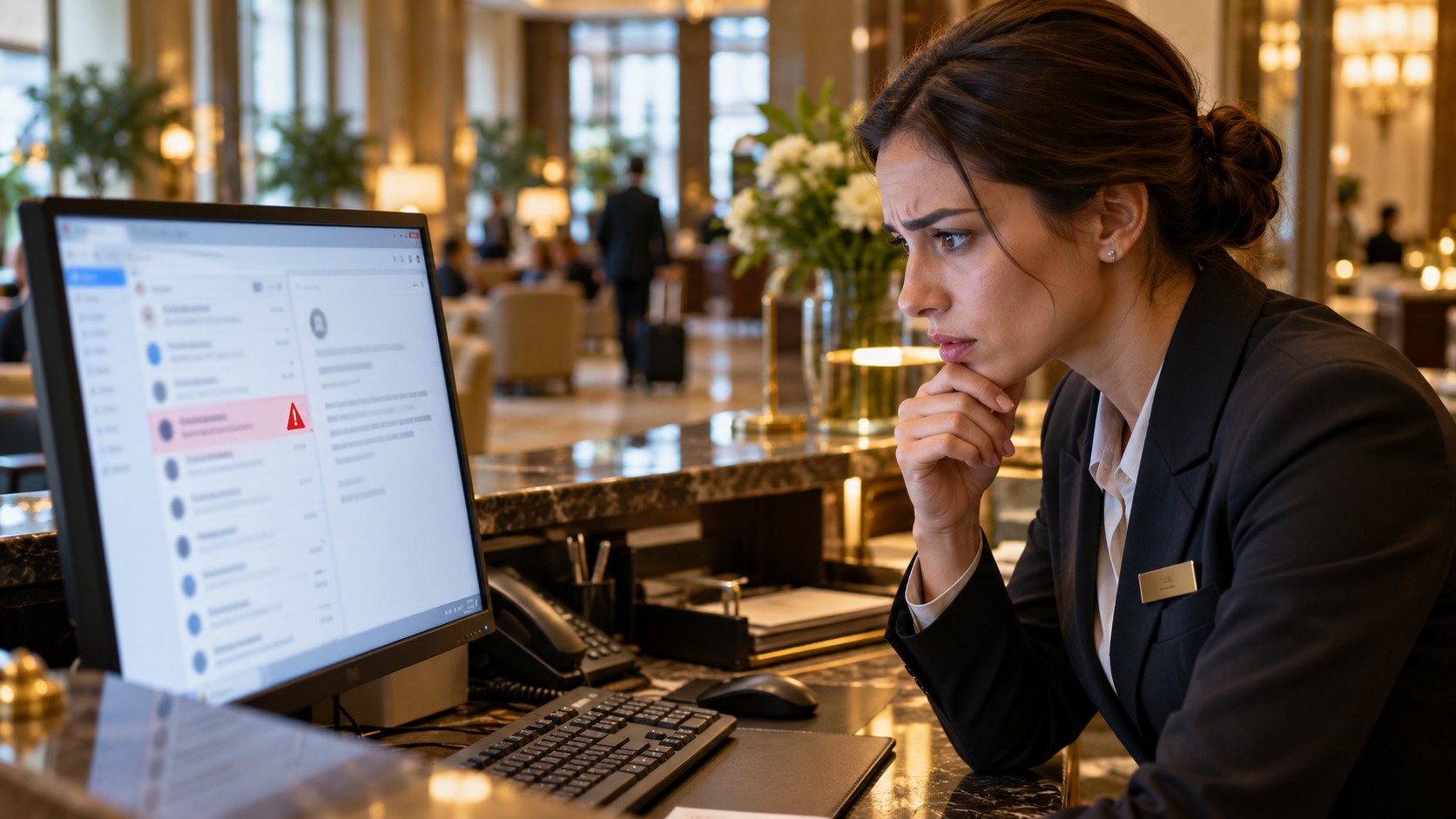
Hotel phishing emails disguised as guest complaints are increasingly targeting properties across Europe and Asia. Nowadays, they’re convincing enough to fool even experienced front-desk staff. Microsoft Threat Intelligence has been tracking the campaign since April 2026, and the attackers clearly understand how hospitality works. The whole operation is built around the industry’s biggest strength: staff who respond to guests quickly and without question.
The stakes are much higher than a single infected laptop or a few customers’ info. One click on the wrong attachment can expose a property’s booking system, payment data and guest records within minutes. So how does one fake email turn into a full operational shutdown, and what would it take to spot the attack before the damage is done?
What Hotel Phishing Emails Look Like Up Close
These aren’t your typical spam messages. The phishing emails Microsoft flagged arrive with subject lines about guest complaints, bedbug sightings, queries about room conditions, and reviews of recent stays. Some even use the display name “Booking Manager (via Calendly)” and route through real scheduling services so they can slip past email security filters entirely. So far, lures have appeared in Japanese, Danish, and Dutch, built more for volume than for pinpoint accuracy.
Inside, there’s usually a link to what looks like a photo. Click it, and a ZIP file downloads that contains a Windows shortcut disguised as an image. Opening that file kicks off a multi-stage attack chain, ultimately dropping a persistent backdoor onto the machine. Think about what sits on a front-desk computer: the property management system, the payment gateway, the booking engine, and every guest record in between. Once an attacker has a foothold there, they’ve got access to everything that matters.
Why Hotels Are Built to Fall for This
Hotels train their staff to be fast and polite above all else. When an email comes in about bedbugs or a broken shower, nobody stops to verify whether the sender is legitimate. The instinct is to respond immediately, apologise, and fix it. Attackers have designed their entire campaign around that reflex, because they know front-desk teams won’t hesitate.
And the machines those teams use sit right at the crossroads of guest data, payment processing, and third-party booking platforms like Booking.com. A single compromised device can hand an attacker stored card details, guest passport scans, Wi-Fi network credentials, and login details for every connected platform. Each system linked to that device becomes another way in, which means the breach grows wider with every passing minute that nobody catches it.
How to Test Whether You’d Actually Catch It
Phishing awareness training has its place, but it won’t tell you what happens after someone clicks. With hotel phishing emails, the real question for any hotel GM or operations manager is whether detection and response processes can catch an intrusion before it reaches payment systems or guest records.
Continuous adversary emulation campaigns, like those run through the WRAITH platform, replicate these exact attack patterns against live environments without any warning. That shows you how your team and your controls actually perform under realistic pressure instead of during a prearranged drill.
What One Click Can Cost a Hotel
Money disappears fast after a successful phishing attack, and not just on the obvious things. There’s the forensic investigation, which doesn’t come cheap. If guest data was exposed, potential ICO fines under UK GDPR will follow, along with compensation claims from affected guests who trusted the hotel with their personal information.
Then there’s the reputational hit when the property’s name shows up in a data breach notification, and that kind of publicity can take years to shake off. For smaller independent hotels, a single incident like this can genuinely threaten the survival of the business.
The Inbox Won’t Protect Itself
Hotel phishing emails aren’t slowing down. If anything, they’re getting harder to identify with each new wave, because attackers are deliberately routing emails through legitimate services to bypass the filters most properties depend on. That traditional first line of defence? Already beaten.
Hotels that will come through this intact are the ones already operating on the assumption that a convincing email will get through eventually, and they’ve tested what happens when it does. That means going beyond staff training and actually checking whether detection, containment, communication, and response hold up when an attacker is already inside the network.
For further context, FEAST Magazine’s coverage of cyber threats facing the hospitality sector explores risks involving guest data, payment systems and staff awareness.
If you haven’t pressure-tested your incident response against a realistic booking-themed attack, the next phishing email that hits your front-desk inbox might answer that question for you, and the answer could carry a price tag nobody budgeted for.