



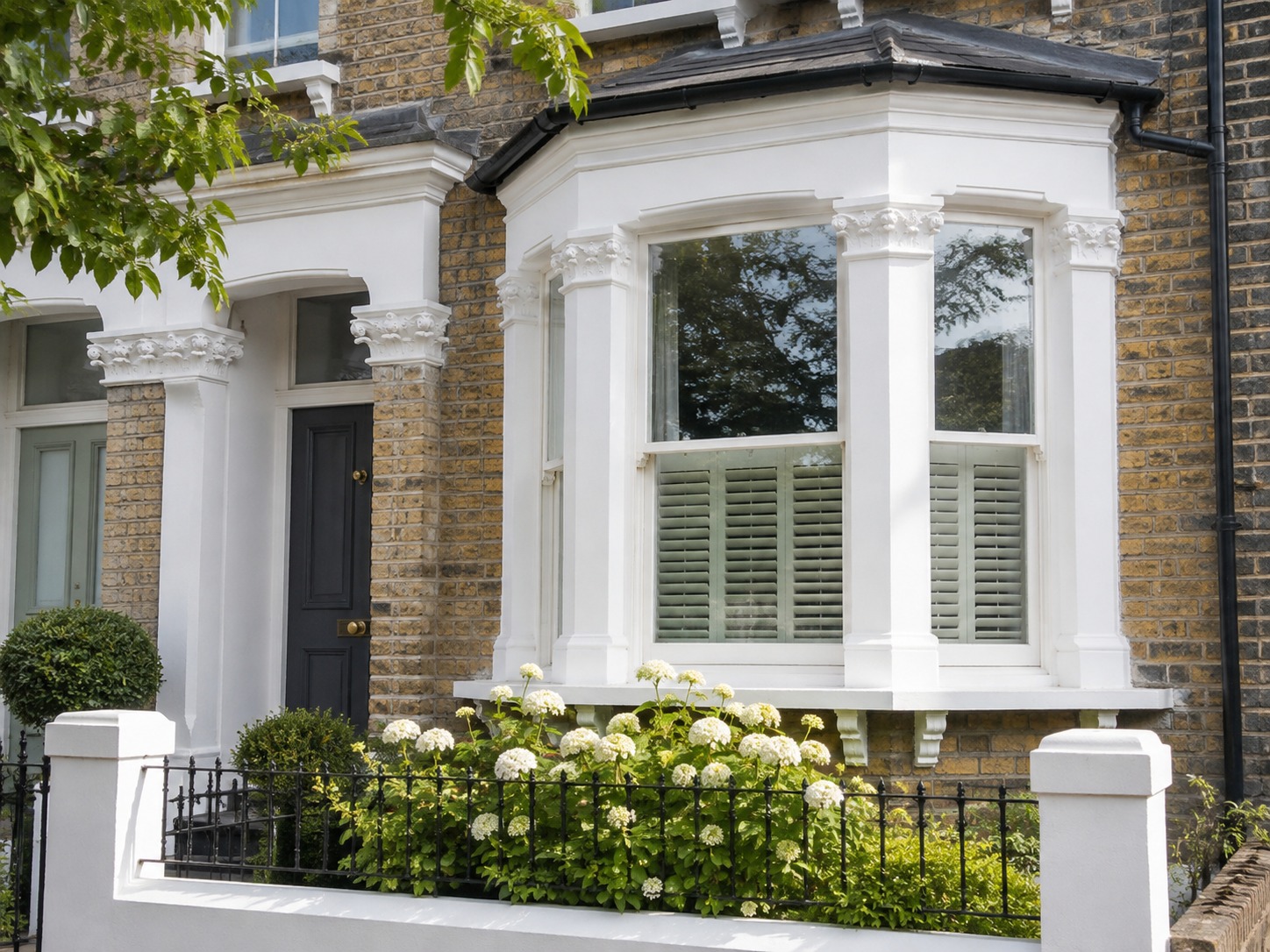
Walk down almost any residential street in Highgate, Muswell Hill or Crouch End, and you are reading a fairly consistent architectural document. Victorian and Edwardian terraces, built within a few decades of each other, sharing brick detailing, front bays and — at the front of nearly every one of them — a timber box sash window.
A hundred and fifty years later, the owners of those houses are offered a great deal of choice their builders never had. uPVC, aluminium, composite frames, all of it marketed on convenience and price. And yet in North London’s period streets, timber remains the material homeowners keep coming back to. That is not nostalgia. There are practical reasons, and they are worth setting out properly.
The Windows Were Designed for the House
A box sash is not simply a window that happens to be made of wood. It is a counterweighted mechanism built into the fabric of the wall, with the weights running in a hollow box behind the frame. The proportions of the glazing bars, the depth of the mouldings, the horns on the meeting rail — all of it was worked out to suit a particular period of building.
When those elements are reproduced in plastic or metal, something goes missing. Extrusion cannot hold the fine profiles that timber can be cut to, so sightlines thicken, glazing bars flatten, and the window starts to look faintly wrong even to people who could not tell you why. On a Georgian or Victorian façade, that difference is noticeable from the pavement.
Repair Almost Always Beats Replacement
Here is the part the replacement market tends not to advertise: most original sash windows do not need replacing. They need work.
Rot is usually localised, concentrating in the bottom rail and the sill where water sits. Sashes stick because paint has built up in the runs, or because a cord has snapped and the balance has gone. Rattling and draughts are almost always a question of worn parting beads and missing brush seals. None of that requires taking the window out.
Spliced repairs let a joiner cut out the decayed timber and let in a new section of matching wood, retaining the original frame. That original timber, incidentally, is frequently better than anything available now — slow-grown, dense, tight-ringed pine that has already proved itself over a century. Specialists in period home sash window restoration London routinely save windows that a replacement salesperson would have condemned on sight.
Replacement has its place. Where a frame has failed structurally, or where a previous owner has already fitted something unsympathetic, a new made-to-measure timber sash is the right answer. But it should be the conclusion of a survey, not the opening pitch.
Conservation Areas Leave Little Room for Manoeuvre
North London is dense with conservation areas — Highgate Village, Muswell Hill, Crouch End, Church End in Barnet, and a good deal of Hackney and Haringey besides. Within them, and on any listed building, what you may do to your windows is constrained.
Councils generally expect original windows to be retained and repaired where that is feasible. Where replacement is genuinely unavoidable, the new units are usually required to match the originals in material, section and opening method. In practice that rules out uPVC and aluminium in most cases, and it means the detail of what gets specified matters as much as the material itself.
Article 4 directions, which remove permitted development rights, apply in parts of several North London boroughs — so work that would be uncontroversial elsewhere can need consent here. Checking with the local planning department before committing to anything is not bureaucratic caution; it is the cheapest step in the whole project.
Timber Outlasts the Alternatives — by Decades
The lifespan argument is straightforward. A well-maintained timber sash window will run for a century or more, and there are plenty in North London doing exactly that. uPVC frames typically reach twenty to thirty years before the seals fail, the plastic discolours, or the hardware gives out.
The difference is not just longevity, it is repairability. A rotten section of timber can be cut out and replaced. A failed uPVC frame cannot be repaired in any meaningful sense — it is removed and thrown away. Over the life of a period house, timber that is painted every eight to ten years and given occasional joinery attention works out considerably cheaper than two or three cycles of plastic replacement.
Modern Performance Without Losing the Profile
The common objection to timber sash windows is that they are cold and draughty. Original ones often are. That is a maintenance condition, not a property of the material.
Draught proofing — routing discreet brush seals into the sashes and frame — deals with most of the problem and is one of the highest-return jobs available on a period house. Beyond that, slim double-glazed units can now be fitted into timber sashes at thicknesses that were not achievable ten years ago, which keeps the sightlines correct while cutting heat loss substantially. Where planning constraints rule out changing the glass, secondary glazing on the inside of the reveal leaves the external appearance untouched altogether.
Firms fitting timber sash windows for North London homes will usually assess these options together rather than treating them as alternatives, because the right answer depends on the window, the room and what the local authority will accept.
The Sustainability Argument Is Not Marketing
Timber is the only mainstream window material that is renewable, and responsibly sourced softwood and hardwood carry a markedly lower embodied carbon figure than uPVC or aluminium.
The stronger environmental case, though, is about retention. The greenest window is the one already installed. Repairing an existing sash keeps material out of landfill, avoids the manufacturing footprint of a new unit entirely, and preserves timber that was felled and seasoned before anyone was measuring carbon at all.
Character Sells in North London
In areas where buyers are specifically looking for period property, original features carry weight. Intact sash windows tend to read as a sign the house has been looked after, while ill-fitting plastic units read as a corner cut — and as a job the next owner will have to redo.
It is one of the few pieces of work on a period house where doing it properly is visible from the street.
What to Ask Before Anyone Touches Your Windows
A few questions separate a joiner who understands sash windows from a general window fitter.
Will you repair before recommending replacement, and can you show me examples? What timber do you use, and where does it come from? How will you match the existing mouldings and glazing bars? Have you worked in conservation areas in this borough? Is the survey free, and is the quote itemised?
Reluctance to give straight answers on any of those is informative.
Getting It Right
Timber sash windows have survived in North London’s period streets for the same reason the houses have: they were built well, and they can be repaired. Treated as something to maintain rather than something to replace, they will comfortably outlast anyone reading this.
For homeowners weighing up the options, sash window repair London by PM Windows starts with a free, no-obligation survey across Highgate, Muswell Hill, Barnet, Haringey, Enfield and Hackney — with an honest assessment of whether your windows need repair, restoration or replacement.