



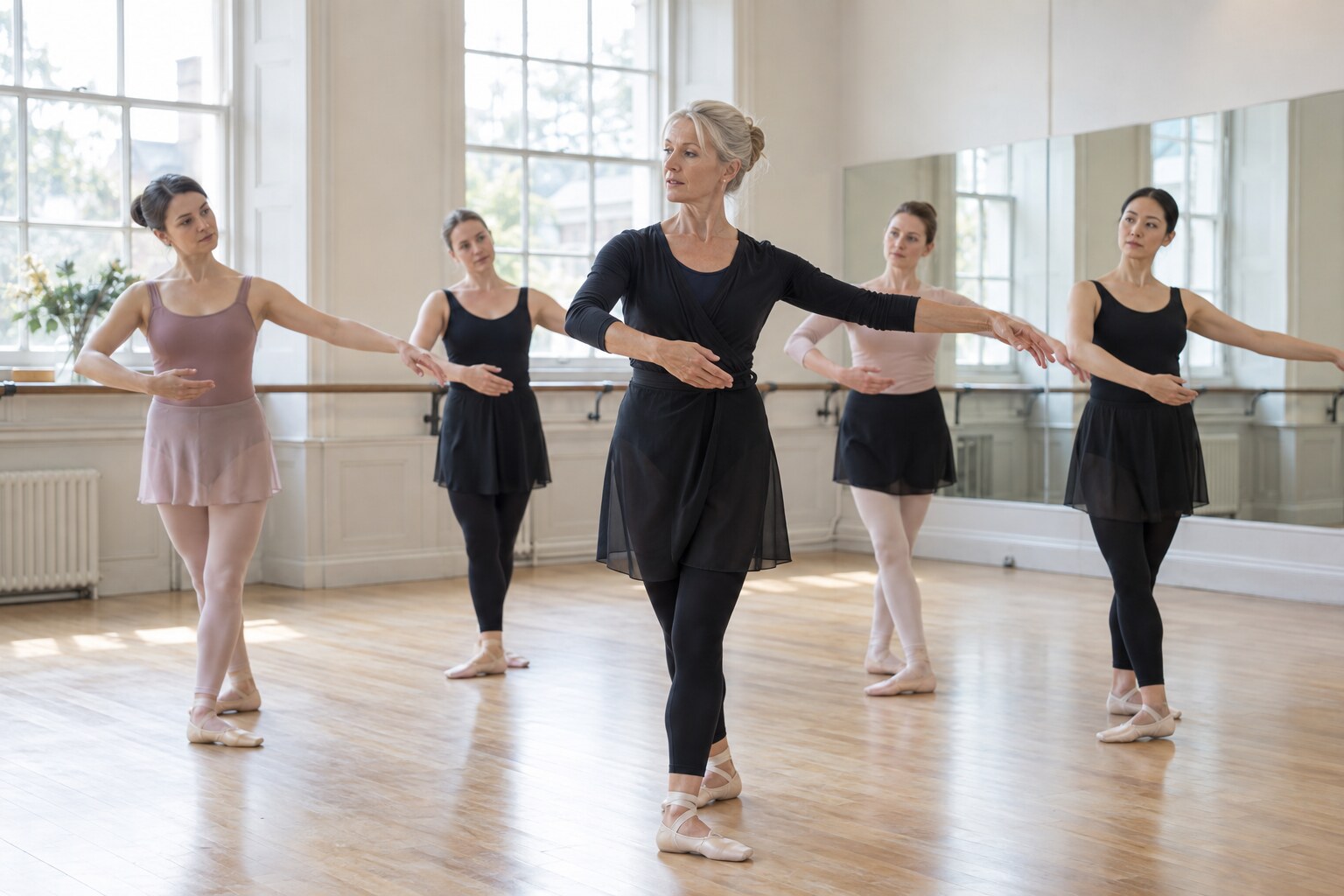
Ballet teachers continue developing their skills long after receiving their initial qualifications. For most registered teachers in the UK, professional training continues throughout their careers through continuing professional development, commonly known as CPD.
That is because the main UK dance teaching organisations treat continuing professional development as a formal condition of maintaining registered status rather than optional extra training. The Royal Academy of Dance requires registered teachers to complete a minimum of 20 hours of CPD every year, and similar expectations apply across the sector:
- RAD registered teachers must complete at least 20 hours per year, divided between structured “time-valued” training and independent study.
- ISTD members should complete a recommended minimum of 18 hours per year, covering syllabus content and broader professional topics.
- bbodance Registered Teachers must complete 18 hours, or three days, of CPD annually, based on an academic year running from September to August.
How Ballet Teachers Complete Their CPD Hours
RAD’s CPD requirement runs on an academic year from 1 September to 31 August. It is divided into two categories: time-valued CPD and independent CPD.
Time-valued CPD includes structured courses, workshops and training sessions attended by a teacher. Independent CPD covers self-directed development, including reading, research and reflective practice.
Teachers who join or reinstate partway through the year receive a proportionally reduced target instead of having to complete the full 20 hours. The requirement gradually decreases until there is no CPD requirement for teachers joining during the final quarter of the CPD year.
bbodance operates on the same September-to-August cycle and expects its 18 hours to be completed within that period. Membership is also due for renewal at the end of the cycle.
This means CPD is monitored annually rather than treated as a one-off requirement after qualifying. Ballet teachers must therefore keep track of their training hours throughout each academic year.
What Ballet Teachers Study During CPD
The content of CPD varies considerably. ISTD reported delivering 382 courses in 2021 alone, providing more than 1,000 hours of training, and its programme extends well beyond syllabus updates.
Alongside technique and examination content, ISTD’s CPD programme covers subjects such as mental health, diversity and inclusion, dance science and running a teaching business. Its courses are also open to non-members.
This variety reflects an important principle shared by many teaching organisations: CPD should support the development of the whole teacher rather than simply keeping someone updated on a particular syllabus.
A teacher who has delivered the same graded exercises for a decade may require less support with the exercises themselves and more guidance relating to child development, safeguarding or the different ways students learn at different ages.
Hour-based requirements provide a basic structure, but the variety of available courses suggests that organisations want to encourage meaningful professional growth rather than simple compliance.
Flexible Training Options for Ballet Teachers
Not all CPD takes the form of a full-day seminar. One Dance UK offers a library of on-demand “CPD Snippets” for secondary school dance teachers, freelance instructors, primary PE teachers and trainee teachers.
Each session lasts approximately 15 minutes and focuses on a single topic, ranging from an introduction to dance to safe teaching practices. This allows busy teachers to complete professional development during a lunch break rather than committing to a full training day.
Short online sessions sit at one end of the CPD spectrum. At the other are longer in-person programmes involving sustained studio work and group discussion. These sessions may be more suitable for teachers who want to explore a subject in detail rather than complete a quick refresher.
These flexible options help ballet teachers complete professional training alongside their regular classes and teaching responsibilities.
Who Pays for CPD and How Much Does It Cost?
CPD is not always free, and its cost usually sits alongside annual membership fees. bbodance’s Registered Teacher membership, which is tied to its 18-hour CPD requirement, costs £210 per year and follows the same September-to-August cycle.
Individual courses offered by organisations such as RAD and ISTD may carry separate fees in addition to annual membership. Prices vary according to the course length, subject and delivery format.
Access conditions also differ. Some courses are limited to members of the organisation providing them, while ISTD explicitly makes its courses available to non-members. One Dance UK also provides at least one free CPD Snippet, allowing teachers to sample the training before subscribing to the complete library.
For teachers comparing several organisations, the availability of free samples, open-access courses and member pricing may be just as relevant as the annual hours requirement. Ballet teachers should compare course fees, membership benefits and accessibility before choosing a CPD provider.
How Ballet Schools Create Their Own CPD Programmes
Alongside national awarding bodies, some ballet schools provide professional development programmes for teachers who already hold recognised qualifications.
The Royal Ballet School’s overview of its teacher training describes two professional development routes designed for teachers at different stages of their careers.
Its Inspire seminars consist of six one-day sessions combining practical studio work with teaching theory. They are suitable for both recently qualified and experienced teachers.
The Enlighten webinars are intended for professionals with an existing level of knowledge. They supplement the seminar series rather than replacing it and offer a more advanced learning route.
Both programmes are designed for practising teachers who want to continue improving rather than individuals looking for an initial route into teaching. The Royal Ballet School deliberately focuses on helping existing teachers become more effective rather than producing new teachers from scratch.
This structure reflects a wider pattern within the sector. Some professional development programmes support teachers who have recently qualified, while others are created for experienced ballet teachers who want to deepen their knowledge.
Why Ballet Teachers Need Ongoing Training
CPD is not designed simply to keep teachers busy. RAD connects CPD directly with Registered Teacher Status, which helps show parents and employers that a teacher’s training is current rather than only historical.
Completing professional development also gives teachers a record demonstrating that they have continued updating their knowledge. This may be valuable if their professional practice is ever questioned.
There is also a practical reason for ongoing training. Teaching methods, safeguarding guidance and knowledge of injury prevention in young dancers have changed over the past decade. A qualification completed early in someone’s career will not automatically reflect later developments.
This focus on professional growth and lifelong learning is not limited to ballet teaching. However, it is especially important in a profession involving the physical development, safety and wellbeing of young dancers.
Annual CPD requirements provide a structured way for awarding bodies to keep working teachers informed about these changes instead of relying entirely on individuals to find updates themselves.
The hours-based model has one clear limitation: it measures the time spent on training rather than what a teacher has actually learned. None of the organisations discussed here publish evidence showing that a fixed annual number of hours improves teaching outcomes on its own.
What the requirement does achieve is a minimum professional standard. It ensures that a teacher’s knowledge is revisited regularly instead of being left unchanged for many years.
Frequently Asked Questions
How Many CPD Hours Do Ballet Teachers Need Each Year in the UK?
Requirements vary by organisation but generally range from 18 to 20 hours annually. RAD requires at least 20 hours, divided between time-valued and independent CPD. ISTD recommends a minimum of 18 hours, while bbodance requires Registered Teachers to complete 18 hours, or three days, each year.
Most requirements follow a CPD year running from September to August.
Does CPD Have to Be Completed in Person?
No. CPD can include in-person seminars, online webinars and short on-demand courses such as One Dance UK’s 15-minute CPD Snippets.
Independent activities, including reading, research and reflective practice, may also count. RAD separates structured time-valued training from independent study when calculating annual hours.
What Topics Count as CPD for a Dance Teacher?
CPD includes syllabus-specific content, such as changes to examination requirements, and broader subjects including child development, safeguarding, dance science, inclusion, mental health and business management.
ISTD delivered 382 courses in 2021, providing more than 1,000 hours of training across different topics.
What Happens if a Teacher Does Not Complete Their CPD Hours?
The requirements and consequences vary between organisations. However, CPD is generally connected to registered or member teacher status, meaning that failing to complete the required hours may affect a teacher’s standing with the relevant awarding body.
RAD reduces the requirement proportionally for teachers who join or reinstate during the CPD year instead of applying the full total retrospectively.
Can Teachers Complete CPD Through Another Organisation?
In many cases, yes. Some professional development programmes, including many ISTD courses, are open to non-members. Teachers may therefore attend seminars, webinars and training courses provided by several organisations throughout their careers.
One Dance UK’s on-demand training is also openly available, with a free sample offered before teachers commit to the full library.
Is CPD Only for Newly Qualified Teachers?
No. Professional development applies throughout a teacher’s career. Some programmes, such as The Royal Ballet School’s Enlighten webinars, are specifically designed for teachers who already possess professional experience and existing knowledge.
The School’s Inspire seminars are suitable for both newer and more experienced teachers.
Does CPD Cost Money in Addition to Membership Fees?
Often, yes. Courses from organisations such as RAD and ISTD may carry separate fees alongside annual membership.
However, free or lower-cost options are also available. One Dance UK provides a free sample from its CPD Snippets collection, while many ISTD courses are open to non-members.
Conclusion
For most UK ballet teachers, qualifying begins a professional training relationship that continues throughout their careers. Annual CPD requirements, syllabus updates, safeguarding guidance, dance science and modern teaching practices all contribute to ongoing development.
With training formats ranging from 15-minute online sessions to intensive in-person programmes, continuing professional development has become a permanent part of professional ballet teaching.
Sources
- Royal Academy of Dance, Why is CPD important for dance teachers?: https://www.royalacademyofdance.org/news-and-facts/why-is-cpd-important-for-dance-teachers/
- Royal Academy of Dance, CPD Requirement for New and Reinstating Teachers: https://assets.royalacademyofdance.org/wp-content/uploads/2024/09/CPD-Requirement-for-New-and-Reinstating-Teachers-Table.pdf
- Imperial Society of Teachers of Dancing, Why is CPD so important for teachers?: https://www.istd.org/teach/continuing-professional-development-cpd/why-is-cpd-so-important-for-teachers/
- bbodance, Registered Teacher: https://bbo.dance/registered-teacher
- Dance Magazine UK, One Dance UK offers on-demand continuing professional development for dance teachers: https://dancemagazine.co.uk/2024/10/one-dance-uk-offers-on-demand-continuing-professional-development-for-dance-teachers/
- The Royal Ballet School, Ballet Teacher Training Courses: https://www.royalballetschool.org.uk/2026/06/26/ballet-teacher-training-courses/