



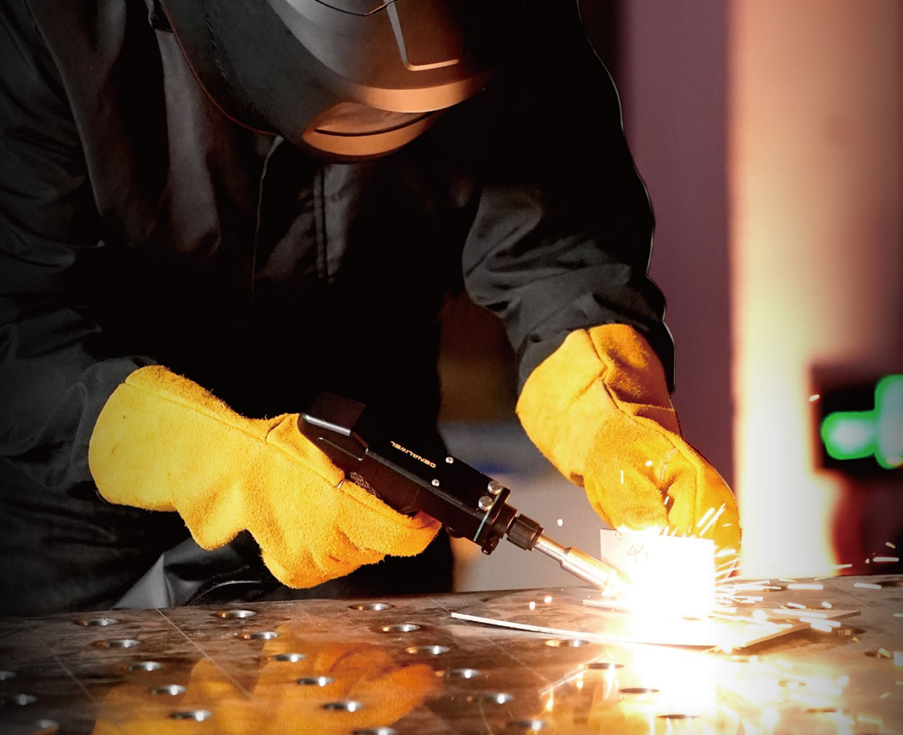
Handheld laser welders are changing how metal joining tasks are carried out. Their focused energy and adjustable controls can support precise, efficient welding in workshops and manufacturing environments.
Understanding how they work helps operators choose suitable settings, recognise their limitations and assess weld quality.
This article explains the core principles behind handheld laser welding, including laser generation, beam delivery, material interaction and the factors that influence results.
Overview of Handheld Laser Welder Technology
Handheld laser welders use a focused laser beam to melt material at a joint. As the molten material cools and solidifies, it forms the welded connection. Many systems use a fibre laser source connected to a handheld welding head.
Key Components
- Laser Source: Generates the energy used for welding. Its power, operating mode and beam characteristics affect the materials and thicknesses the system can handle.
- Cooling System: Controls equipment temperature. Cooling arrangements vary between models and should suit the intended workload.
- Control Mechanism: Allows operators to adjust settings such as laser power, beam movement and, where supported, pulse parameters.
- Welding Head: Directs and focuses the beam onto the joint. Some systems also incorporate shielding gas delivery and wire feeding.
Advantages
- Speed: Suitable applications can be completed faster than with some conventional welding processes.
- Precision: Concentrated energy can help limit the area heated around the joint.
- Handling: The handheld head allows flexible positioning, although the complete system also includes the laser source, cooling equipment and other components.
A hand held laser welder offers features for different welding applications. The appropriate model depends on the materials, joint design and production requirements.
Fundamental Working Principles
Handheld laser welders concentrate energy onto a small area of metal. The material absorbs this energy, heats up and forms a molten pool at the joint.
Depending on the system and application, the laser may operate continuously or in a pulsed mode. Weld quality depends on the combination of power, travel speed, focus, joint preparation and material properties.
Laser Source Characteristics
Fibre lasers are commonly used in handheld welding systems. They deliver concentrated energy through an optical fibre to the welding head.
Important characteristics include:
- Wavelength: Influences how the material absorbs the laser energy.
- Power Range: Determines the available energy input.
- Operating Mode: Continuous or pulsed operation affects how energy is delivered.
- Beam Quality: Influences focusing and energy concentration.
The suitability of a laser source should be assessed against the intended materials and welding procedure.
Beam Delivery and Focusing
The beam travels through the delivery system to the handheld welding head. Optical components focus it onto the joint.
A concentrated beam can produce localised heating, helping reduce distortion in suitable applications. Some welding heads move the beam across a controlled pattern to adjust the weld width.
Correct focus, head positioning and travel speed remain important. Poor setup can lead to incomplete fusion, inconsistent penetration or other defects.
Metal Interaction Dynamics
When the beam reaches the metal, absorbed energy heats the surface and forms a molten pool. As the welding head moves along the joint, the pool cools and solidifies behind it.
The final connection depends on more than its appearance. Joint fit-up, surface cleanliness, penetration and the absence of unacceptable defects all influence performance.
Some applications can be welded without filler wire. Others require filler to accommodate gaps, achieve the required weld shape or support the specified material combination.
Shielding and Auxiliary Gas
Shielding gases help protect the molten weld from unwanted reactions with the surrounding atmosphere.
Gas selection depends on the material and welding procedure. Argon and nitrogen are used in some applications, but they are not interchangeable for every metal.
Correct gas flow and nozzle positioning help maintain protection around the weld. Contamination or inadequate shielding can affect weld quality.
Why Understanding Handheld Laser Welder Principles Matters
Understanding the process helps operators make better decisions about settings, preparation and inspection.
- Improved Efficiency: Suitable settings and joint preparation can reduce processing time and unnecessary rework.
- Precision and Control: Adjusting power, travel speed and beam settings helps match the process to the application.
- Versatility: A suitable system can handle different joint types and materials within its stated capabilities.
- Quality and Reliability: Controlled heat input can reduce distortion, while inspection confirms whether the weld meets the required standard.
Ease of handling does not remove the need for training. Operators must understand both the welding process and the hazards associated with the equipment.
Materials Compatibility and Typical Uses
Handheld laser welders from Denaliweld can be assessed for applications involving different metals. Buyers should check the specific model’s documented capabilities and obtain application trials where necessary.
Material grade, thickness, surface condition and joint design all influence suitability. Reflective materials and dissimilar metal combinations can present additional challenges.
Thin or heat-sensitive components may benefit from localised heating, but the process still requires appropriate settings and validation.
Typical applications can include:
- Sheet-metal fabrication
- Suitable repair work
- Component assembly
- Decorative metalwork
- Production of housings, cabinets and enclosures
Materials Compatibility and Typical Applications
| Material | Compatibility Considerations | Potential Applications |
|---|---|---|
| Aluminium | Depends on alloy, reflectivity, power and procedure | Fabricated components and enclosures |
| Stainless steel | Requires suitable settings and shielding | Sheet-metal assemblies and cabinets |
| Titanium | Requires carefully controlled shielding and a suitable procedure | Specialist components |
| Dissimilar metals | Requires assessment of metallurgical compatibility | Validated specialist joining applications |
| Thin metal sections | Requires control of heat input and joint fit-up | Decorative work and lightweight assemblies |
Applications in demanding sectors require the relevant procedure qualification, inspection and approval. A machine’s ability to melt a material does not automatically establish its suitability for a safety-critical component.
Safety and Regulatory Considerations
Safe operation involves more than the controls built into the machine. Employers also need suitable training, a controlled working area and protective measures appropriate to the laser system.
FEAST Magazine’s article on how technology supports safety in non-office workplaces explores the wider role of technology and training in workplace safety.
Safety features vary between models and may include:
- Emergency Stop Controls: Allow the operator to stop the equipment in an emergency.
- Interlocks: Help prevent operation when specified safety conditions are not met.
- Key Switches and Access Controls: Restrict activation to authorised users.
- Monitoring Systems: Detect certain equipment faults or unsuitable operating conditions.
Built-in features do not replace a properly assessed laser-controlled working area. Direct and reflected laser radiation can create serious hazards for operators and other people nearby.
Safe working arrangements should address:
- Laser-specific eye protection selected for the system
- Suitable barriers or enclosures
- Access restrictions and warning signs
- Fume extraction and ventilation
- Fire prevention
- Protection of nearby workers
- Equipment inspection and maintenance
- Manufacturer-approved operating procedures
For UK installations, purchasers and employers should check the applicable product and workplace safety requirements. Relevant documentation may include conformity information and standards such as BS EN ISO 11553-2, where applicable to the equipment.
The required conformity marking and documentation depend on the market and applicable rules. Buyers should verify these details for the specific machine rather than rely on a general marketing claim.
Selection Criteria for Integration
Choosing a handheld laser welder requires consideration of the complete working setup.
| Aspect | What to Check |
|---|---|
| Materials and thicknesses | Confirm suitability through documented specifications and representative welding trials. |
| Joint design | Assess access, fit-up, required penetration and filler-wire needs. |
| Cooling and production workload | Check whether the system supports the intended operating pattern. |
| Ergonomics | Consider head weight, cable handling and operator positioning. |
| Electrical supply | Confirm that the available supply meets the equipment requirements. |
| Safety arrangements | Include the controlled area, protective equipment, extraction and training in the installation plan. |
| Support and maintenance | Check access to servicing, replacement parts and technical assistance. |
Conclusion
Handheld laser welders use focused laser energy to melt and join metal. Their performance depends on the laser source, beam delivery, material properties and the welding procedure.
Before selecting a system, consider the metals, thicknesses and joint types you