



Quick Answer
Some of the best free things to do in London include visiting the British Museum, Natural History Museum, Science Museum, National Gallery and National Maritime Museum; walking the South Bank or Regent’s Canal; watching Changing the Guard; exploring Greenwich Park; and booking a free skyline visit at Sky Garden. General admission is free at the major museums listed here, although temporary exhibitions, special experiences and some family galleries may charge. A few free attractions also use timed tickets, so checking the official website before travelling can save a wasted journey.
London’s reputation for being expensive is deserved in some areas. A last-minute Tube journey, coffee near a major landmark and an unplanned lunch can turn a supposedly cheap day out into a surprisingly costly one. Yet admission fees are not the main obstacle. London has national museums that remain free, large public parks, historic streets, riverside routes and elevated gardens that cost nothing to enter.
The key is to group places by area. Trying to cross the city repeatedly wastes time and adds transport costs. A museum morning in South Kensington, a central London walking route or a full Greenwich day usually works better than ticking off unrelated attractions at opposite ends of the Tube map.
What “Free” Actually Means in London
Every recommendation in this guide has a free core experience, but “free entry” does not always mean every part of the venue is free. Major museums often charge for temporary exhibitions. Rooftop viewpoints may require booking. Markets are free to browse, but the food is not. Public ceremonies can also change because of weather, security or operational requirements.
| Practical rule Before leaving, check the attraction’s official page for opening times, closures and ticket requirements. Free tickets are not a payment trap; they are usually a way to manage capacity and reduce queues. |
Free Museums and Galleries Worth Your Time
1. Start with the British Museum, but choose a theme
The British Museum is too large to “complete” in one visit, and treating it like a checklist is the quickest way to become exhausted. Its permanent collection is free, with timed booking recommended. A better plan is to choose one or two themes – ancient Egypt, the history of writing, money, the ancient Mediterranean or objects connected to a particular country – and leave while the visit is still enjoyable. Bloomsbury is also easy to combine with Russell Square, the bookshops around Gower Street and a walk towards Covent Garden.
2. See the Natural History Museum before the afternoon rush
The building is part of the experience. Even visitors with only a passing interest in natural history tend to appreciate the grand Romanesque hall, the mineral displays and the sheer scale of the collections. General admission is free, but advance tickets are sensible during weekends and school holidays. Arriving close to opening time usually makes the central spaces easier to enjoy. Some temporary exhibitions and special attractions have separate charges.
3. Pair the Science Museum with South Kensington
The Science Museum is one of the strongest free options for families because its permanent galleries cover space, engineering, medicine, mathematics and everyday technology. General entry is free and pre-booking is required. Paid attractions sit alongside the free displays, so families can still build a full visit without buying extras. Because the Natural History Museum and Victoria and Albert Museum are nearby, South Kensington works particularly well on a wet day.
4. Visit the National Gallery with a five-painting plan
The National Gallery overlooks Trafalgar Square and offers free general admission. Rather than moving room by room, choose five works or artists in advance and build a route around them. This makes the collection feel less overwhelming and gives first-time visitors a clear sense of purpose. A free booking can provide faster entry, while major ticketed exhibitions remain separate.
5. Use Tate Modern as part of a riverside walk
Tate Modern makes most sense when it is not treated as an isolated museum stop. Walk there along the Thames, spend time in the free collection displays and continue across the Millennium Bridge or towards Borough Market. The former power station’s scale, industrial interior and changing contemporary collection give the visit a different rhythm from London’s historic galleries. Temporary exhibitions may be ticketed.
6. Make Greenwich’s National Maritime Museum part of a full day
The National Maritime Museum is free and does not normally require booking, although reserving a free ticket can help guarantee entry. Its galleries explore exploration, trade, migration, conflict and life at sea. It is especially useful as a weather-proof stop within a larger Greenwich itinerary that also includes the Queen’s House, riverside streets and Greenwich Park. Some children’s experiences and nearby attractions, including the Cutty Sark and Royal Observatory, are paid.
Related FEAST reading: The Ultimate Guide to Museum Hopping in London offers a useful internal link for readers who want to build a museum-focused itinerary.
Free Walks, Streets and Public Spaces
7. Walk the South Bank from Westminster to Bankside
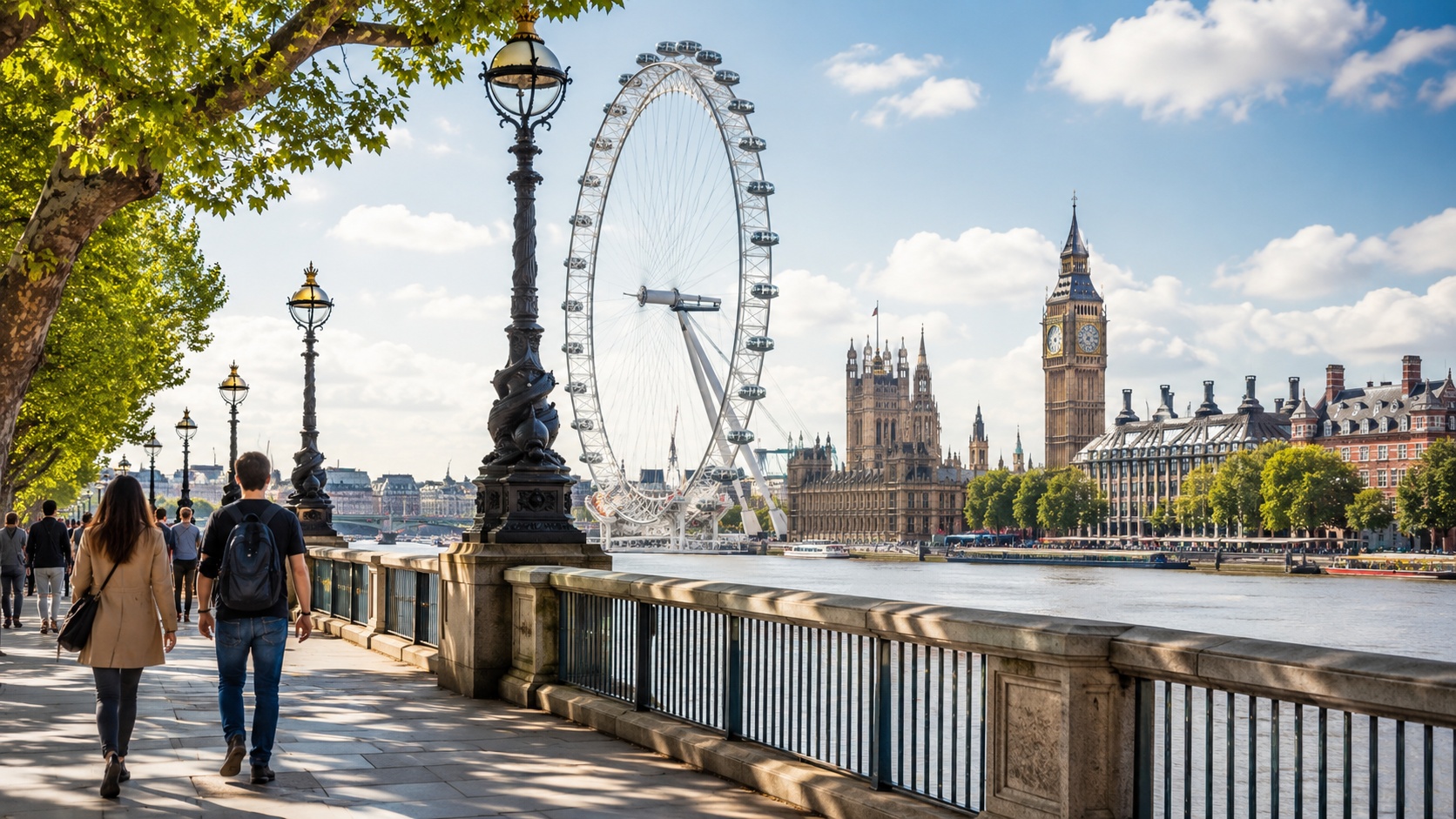
For a first-time visitor, the South Bank delivers more recognisable London views per mile than almost any other free route. Start near Westminster Bridge, pass the Southbank Centre and National Theatre, browse the second-hand book stalls when they are operating, and continue towards Tate Modern. The London Eye and river cruises cost money, but the views of Parliament, St Paul’s and the Thames do not. The route is busiest in the middle of the day, so mornings and early evenings feel less compressed.
8. Cross Trafalgar Square slowly rather than using it as a shortcut
Trafalgar Square is often treated as a place to walk through on the way to somewhere else. It is more interesting when you stop to notice the Fourth Plinth, the fountains, the views towards Whitehall and the constant change in public life around the square. Pair it with the National Gallery, St James’s Park or a walk through Soho to turn a short stop into a practical central London route.
9. Watch Covent Garden’s street performers
Covent Garden’s licensed street performers include musicians, magicians, dancers and comedians. Watching is free, although performers understandably welcome voluntary tips. The quality and timing vary, which is part of the appeal: there is no fixed show to rush towards. The market building, surrounding lanes and nearby Seven Dials make this a better option than visiting only for a photograph.
10. Walk through Leadenhall Market when the City is quiet
Leadenhall Market is a covered Victorian market in the City of London. It is busiest around weekday lunch, when nearby offices fill the shops and food outlets. For architecture and photography, early mornings, later afternoons or weekends can be calmer. It is free to walk through and easy to combine with The Garden at 120, St Dunstan in the East and views of the City’s modern towers.
11. Find the ruins of St Dunstan in the East
St Dunstan in the East is a small public garden formed within the ruins of a church damaged during the Second World War. Climbing plants and trees soften the remaining stonework, creating a quiet break from the surrounding financial district. The garden is compact, so it should be part of a City walking route rather than the only reason for a long journey.
12. Follow Regent’s Canal instead of another shopping street
Regent’s Canal offers a different version of London: towpaths, narrowboats, bridges and pockets of greenery rather than monuments and department stores. A manageable section runs between Little Venice and Camden, although the towpath can become narrow and crowded. Walkers should share the route carefully with runners and cyclists. The canal is best in daylight and is less suitable when the path is icy or heavily flooded.
13. Explore Shoreditch through its changing street art
Street art in Shoreditch is temporary by nature. A mural praised in an older guide may have been painted over, which is exactly why the area rewards repeat visits. Start around Brick Lane and move into the smaller streets rather than hunting for one famous wall. Look beyond the largest pieces: shutters, paste-ups and small interventions often reveal more about the neighbourhood’s visual character.
Free Parks, Gardens and Skyline Views
14. See London open up from Greenwich Park
Greenwich Park is one of the capital’s eight Royal Parks and is free to enter. The slope near the Royal Observatory provides one of London’s most satisfying skyline views, with historic Greenwich in the foreground and Canary Wharf beyond. The park covers far more than the famous viewpoint, including formal gardens, ancient trees, wildlife habitats and quieter paths away from the main hill. Pedestrian-gate times change seasonally, so check before an evening visit.
15. Choose one Royal Park and stay long enough to notice it
Hyde Park, Kensington Gardens, Regent’s Park, St James’s Park, Green Park, Richmond Park, Bushy Park and Greenwich Park are all free to explore. Visitors often rush through them between attractions, but each has its own character. St James’s Park works well with Buckingham Palace; Hyde Park and Kensington Gardens fit a museum day; Richmond Park is better for a longer nature-focused visit. Wildlife should be observed from a respectful distance, particularly deer.
16. Book Sky Garden for a free elevated view
Sky Garden offers free public access, but timed tickets are limited and usually released in advance. The indoor garden and viewing areas provide broad views across the Thames and central London. Booking is the safest option, particularly at weekends, and visitors should arrive with enough time for security checks. The viewing experience is free; restaurants and drinks are optional purchases.
17. Try The Garden at 120 when Sky Garden is full
The Garden at 120 is an open-air rooftop garden on the 15th floor and is free to enter. It sits lower than Sky Garden, but that can make the nearby City architecture feel more immediate. Planting, water features and open sightlines create a relaxed place to pause during a walking route. Opening arrangements can change because it is exposed to the weather, so checking the official website remains sensible.
18. Climb Primrose Hill for a sunset that costs nothing
Primrose Hill is popular because the skyline view is clear, informal and easy to combine with Regent’s Park or Camden. Sunset draws crowds, especially in warm weather. Arriving earlier provides more space and avoids turning the visit into a search for an empty patch of grass. As with all public parks, take rubbish away and keep noise considerate for nearby residents.
19. Use Parliament Hill for a broader, less polished panorama
Parliament Hill on Hampstead Heath provides a wide view across London rather than the close-up central-city perspective offered by rooftop gardens. The walk is part of the appeal. Hampstead Heath’s uneven paths and open ground feel removed from the formal centre, making it a strong choice for visitors who would rather spend half a day outdoors than move between buildings.
Free London Traditions and Seasonal Experiences
20. Watch Changing the Guard, but check the calendar first
Changing the Guard is free to watch, yet it is not a spontaneous daily show. The official Household Division calendar should be checked because dates and arrangements can change. The Buckingham Palace ceremony begins in the late morning, and arriving early improves the chance of a useful view. Visitors who dislike dense crowds may prefer watching parts of the procession near St James’s Palace or along the route rather than standing directly at the palace railings.
21. Browse a London market without turning it into a shopping mission
Borough Market, Camden Market, Portobello Road and Old Spitalfields Market are free to enter and browse. They are not free food experiences, but they can still be enjoyable without buying anything if the goal is architecture, atmosphere and people-watching. Visiting outside peak lunch hours reduces congestion. Anyone photographing traders or close-up displays should ask permission rather than treating working stalls as scenery.
22. See Piccadilly Circus, Chinatown and Soho after dark
One of the easiest free evening routes starts at Piccadilly Circus, continues through Chinatown and finishes in Soho or Covent Garden. The screens, signs and busy streets create a completely different mood after sunset. This is not a quiet walk, but it is central, well-lit and easy to adapt. Keep normal city awareness around phones and bags, particularly in crowded areas.
23. Build a visit around a free annual event
London’s calendar includes free festivals, parades, public art and cultural events throughout the year. Notting Hill Carnival is the best-known example, but smaller neighbourhood programmes can be easier to navigate. Dates, routes, security arrangements and transport changes should always be checked close to the event. Free does not necessarily mean effortless: major events can involve large crowds, road closures and limited mobile signal.
Best Free Things to Do in London with Kids
For families, the strongest free options are the Natural History Museum, Science Museum, National Maritime Museum, Greenwich Park and the central Royal Parks. The museums provide shelter when the weather is poor, while Greenwich offers space to move between indoor and outdoor stops. Not every interactive gallery is free, so parents should check individual attraction pages rather than assuming the whole venue operates under one ticket policy.
A realistic family day should include fewer stops than an adult sightseeing itinerary. One major museum, a park and a simple walk are usually enough. Booking an early museum slot also reduces the chance that younger visitors spend the best part of their energy standing in a queue.
Related FEAST reading: The Top 5 Things to Do This Summer in London: A Guide for Families can support this section as an internal link, although its dates and individual recommendations should be reviewed before republishing.
Free Things to Do in London at Night
London’s free evening appeal is mostly about atmosphere rather than attractions. Walk the South Bank as the bridges and riverside buildings light up, take the Piccadilly Circus-Chinatown-Soho route, or look for late opening hours at major museums and galleries. Late programmes can change and may require free booking, so they should not be presented as permanent weekly fixtures without checking.
For skyline views, a timed Sky Garden booking can extend into the evening depending on the day and season. Outdoor viewpoints such as Primrose Hill are better approached with practical judgement: stay on recognised paths, check park closing times and avoid isolated areas late at night.
A One-Day Free London Itinerary
Morning: Bloomsbury and Covent Garden
Book a morning slot at the British Museum and focus on two or three galleries. Walk south through Bloomsbury towards Covent Garden, stopping for the public spaces and any street performances rather than treating the market as a shopping requirement.
Afternoon: Trafalgar Square and the National Gallery
Continue to Trafalgar Square and spend 60 to 90 minutes in the National Gallery using a short list of works. From there, walk through Whitehall or St James’s Park depending on energy levels and weather.
Evening: Westminster and the South Bank
Cross towards the Thames and finish with a South Bank walk. The route provides views of Parliament, the London Eye, the river and the City skyline without requiring an attraction ticket. Food and transport will still cost money, so bringing water and setting a meal budget keeps the day genuinely affordable.
How to Keep a “Free” London Day Affordable
- Group attractions by neighbourhood rather than crossing London several times.
- Book free timed tickets as soon as the day is confirmed.
- Carry water and a small snack; convenience purchases near landmarks add up quickly.
- Use contactless travel carefully and check whether walking one stop is practical.
- Treat markets as places to browse unless food spending is already in the budget.
- Check official websites on the morning of the visit for closures or changed ceremony times.
Frequently Asked Questions
What attractions are completely free in London?
Many national museums and galleries offer free general admission, including the British Museum, Natural History Museum, Science Museum, National Gallery and National Maritime Museum. Royal Parks, public squares, canal paths and riverside walks are also free. Temporary exhibitions and special experiences may charge.
Are London museums really free?
A large number of London’s major national museums are free for their permanent collections. Some request or require a free timed ticket, and paid exhibitions may operate inside the same building.
What can families do in London for free?
Families can visit the Natural History Museum, Science Museum and National Maritime Museum, explore Greenwich Park, watch street performers in Covent Garden or follow a short South Bank route. Check whether individual children’s galleries carry a separate charge.
Do free London attractions require booking?
Some do. Sky Garden uses timed entry, while major museums may recommend or require free booking to manage visitor numbers. Parks, public streets and most walking routes do not need tickets.
What are the best free things to do in London at night?
The South Bank, Piccadilly Circus, Chinatown and central Soho are popular after-dark options. Museum late openings and free evening events can also be worthwhile, but schedules should be verified on official websites.
Is Sky Garden completely free?
Public access is free during the stated visiting hours, but a timed ticket is strongly recommended and capacity is limited. Restaurants, bars and food purchases are not included.
Final Thoughts
The best free things to do in London are not second-rate versions of paid attractions. Several are among the city’s defining experiences: national collections, Royal Parks, public ceremonies, river walks and skyline views. The difference between a satisfying low-cost day and a tiring one is usually planning. Choose one area, reserve any free tickets, leave space for walking and accept that London is better experienced selectively than conquered in a single day.
Opening times, ticket rules and event schedules can change. This guide was fact-checked against official visitor information on 31 July 2026; readers should confirm details directly before travelling.