



Trekking to the Everest Base Camp has been popular for its unadulterated beauty and physical challenges. However, there is yet another tale being told in this context, which never gets talked about in blogs related to trekking. That story has to do with the connectivity of Sherpas living in perhaps the remotest region of the world, and the story has evolved significantly in the past decade. This changing Himalayan connectivity is reshaping how local communities stay in touch
The Old Way: Radios, Runners, and Waiting
Not too long ago, communication in the Khumbu valley was a luxury. When you had something that needed to be communicated, you traveled. Villages such as Khunde and Khumjung, where there were around 1,700 inhabitants, had poor mobile reception even a few years back. They needed to walk a bit far away just to catch one bar of the reception.
There were radio devices and satellite phones around, but those were for mountaineers and rescue teams. To keep in touch with family members who lived miles away, they had to plan things ahead.
When the Towers Went Up
The turning point occurred when telecom companies realized that the Khumbu area was valuable enough to get connected. Ncell and Nepal Telecom (NTC) started putting up base stations in the Everest Base Camp Budget Trek region, and the challenge was how to get power for them because there was no grid to plug into.
The answer was solar power. Every single base station in the Khumbu region works on solar panels and batteries, as no other source of power can be used at such heights. Equipment was manually transported to these heights, and towers were constructed on ridges from which line of sight transmissions could be done to the valleys down below.
Nowadays, there are ten Ncell base stations in the Khumbu area, each one solar-powered. The outcome is something that would have been unthinkable two decades back – 3G and 4G coverage in villages located days from the nearest road.
Fiber in the Mountains: The Khumjung Project
The best example of this is found in Khumjung and Khunde villages. The initiative made it possible to install 8.3 kilometers of optical fiber cable between Syangboche and these villages in May 2023. The trenches were dug manually by locals without any mechanical equipment or helicopters. Only shovel work was involved.
The internet is provided at a cost of about 500 Nepali rupees ($3.75) per month to homes and lodges, while it has also connected the school, hospital, and community clubs. More than one hundred homes and lodges are connected through this network.
No certifications were possessed by the people who joined the cables together. They gained knowledge by watching YouTube videos and learning through experience. They have been able to set up optical fiber cables all the way up to the Everest Base Camp.
What This Means for Trekkers
However, for someone visiting Everest Base Camp, the existence of this infrastructure would hardly be recognized as something special. You purchase an NTC SIM card in Kathmandu, receive signals in Lukla and Namche, share photos of the mountains and lose signals somewhere after Tengboche.
For the local population, it is quite different: it is related to their business activities, checking on the family living in Kathmandu, and receiving telemedicine services. For the local community, it means that even living at the height of 4,000 meters (13,123 feet), they will not be isolated from the rest of Nepal.
This connectivity has its peculiarities. Namche Bazaar and Lukla have the best reception of 4G signals with speeds of up to 10 Mbps. After Tengboche, the signals become weaker; after Gorak Shep, one can call but not use mobile data. And there is neither Wi-Fi nor mobile connections at all in Everest Base Camp.
The Cost of Staying Connected
The connection in the Khumbu is not always cheap. It can be rather expensive, but it is understandable why. In case you want to charge your phone in one of Lukla’s teahouses, expect to spend around NPR 100 to 300 (one to three dollars). In Dingboche or Lobuche, it will be NPR 300 to 600 (three to six dollars). And in Gorak Shep, it may even cost you five dollars, not mentioning whether it is going to work there or not.
Wi-Fi connection is equally expensive. The Everest Link prepaid card can be used in Lukla through Gorak Shep. Price depends on the altitude. So, it will cost you NPR 1,200 in Namche and NPR 1,800 in Gorak Shep.
It is the best option for a budget trekker to have a 20,000mAh power bank. Such a thing costs between $30 and $50 and charges your phone four to five times.
What Locals Do Differently
There is evidence of adaptation by Sherpa families to this new condition without much awareness by trekkers. For example, owners of lodges use WhatsApp to plan bookings and procurement. Guides consult phone weather predictions to determine whether to cross a high pass. Parents whose children attend school in Kathmandu use mobile data to keep in touch with them.
New opportunities for economic activities have been created by the Internet as well. Some women from the Sherpa community have turned to entrepreneurship through the Internet by engaging in business activities like handicraft trade or homestays. An innovation lab and telehealth clinic are being developed in Khunde through this new Internet connectivity.
A Shared Experience
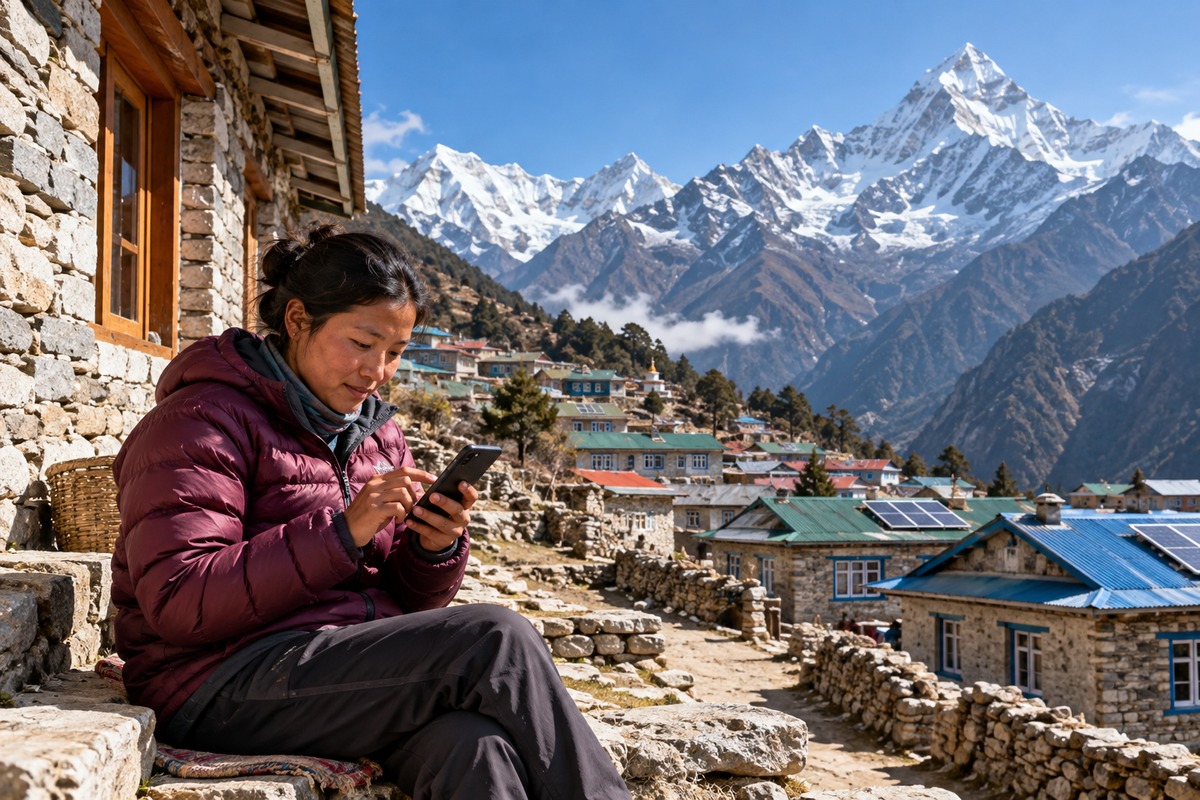
But there is one time during the Everest Base Camp trek that highlights this new reality. You are passing through a village at the height of 4,000 meters. A Sherpa lady is sitting at the entrance to her hotel and surfing her phone. A guide is consulting the weather on his NTC network. A group of trekkers are gathered in the dining hall around a WiFi hotspot.
Everyone is doing exactly the same thing. They are maintaining their connection. In such remote locations of the Himalayas, it is not anymore a wonder, but just routine. For those communities who are living in such places, it is only right.
Final Thoughts
However, connectivity in the Khumbu region is not simply a case of technology use. Connectivity here is also a matter of people connecting themselves in spite of distance. The Sherpas are known for their adaptability and resourcefulness; they have been able to build monasteries at high altitudes; they carved paths where there appeared none possible; and they climbed up mountains carrying goods that most people will only see in pictures. Now, they have created a communication network right on top of the world.
The significance of this goes well beyond the Khumbu region. It demonstrates what is possible when communities take the lead in developing remote regions. The fiber network in Khumjung was not the work of the government. It was dug with shovels by local people. The solar towers that support them were not installed by foreign engineers.
For readers of FEAST Magazine UK, this offers a closer look at the everyday work behind remote hospitality, from keeping lodges supplied to helping families and visitors stay in touch.
There is a lesson for trekkers. The bars on your cell phone signal in Namche are no accident. They are due to the many years of efforts by those who would not accept isolation. When you upload that picture from the trail, keep in mind the hands behind its creation.
The Himalayan region is always going to be remote. This is one of the things that make them powerful. But this does not mean that remote equals silent anymore.