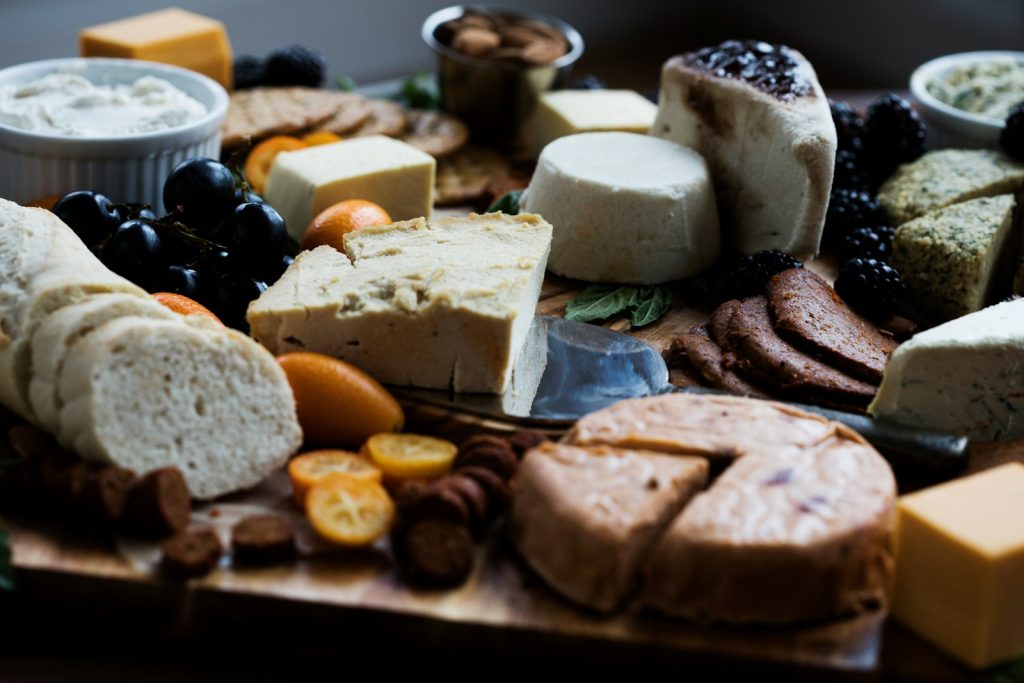
Allow about 80g of cheese per person if the board follows a big meal, and 150g or more if it is the main event, then choose three or four cheeses: a hard cheese, a soft one, a blue and a goat’s cheese. That is the advice of two of Britain’s best-known cheesemongers, and the rest of this guide shows how to put it into practice.
How much cheese do you need per person?
It depends on when the board appears. Paxton & Whitfield suggests about 80g each after a main course, with around 750g in total for six people, rising to 150g to 200g each when cheese is the supper.
Hero Hirsh, a cheesemonger at Paxton & Whitfield, told lovefood to allow 100g to 125g per person for a meal, and about 150g at Christmas, when the board tends to stay out for longer.
| Number of guests | After a big meal (80g each) | With a meal (125g each) | Christmas grazing board (150g each) |
|---|---|---|---|
| 4 | 320g | 500g | 600g |
| 6 | 480g (Paxton & Whitfield suggests about 750g) | 750g | 900g |
| 8 | 640g | 1kg | 1.2kg |
| 10 | 800g | 1.25kg | 1.5kg |
| 12 | 960g | 1.5kg | 1.8kg |
If you are between two amounts, round up: Hirsh’s higher Christmas figure allows for a board that stays out through the afternoon.
How many cheeses should go on a cheese board?
Three or four. Paxton & Whitfield says any more is too much for the palate, and Hirsh adds that fewer varieties in larger pieces keep better once cut.
The classic trio is Cheddar, Stilton and Brie, which gives you a hard, a blue and a soft cheese. Add a goat’s cheese as the fourth and you have a balanced board with different milks, textures and strengths.
Which British cheeses should you put on a Christmas cheese board?
These are the British cheeses we would build a board around, with details from their makers and sellers.
| Cheese | Type | Why it works |
|---|---|---|
| Montgomery’s Cheddar, Somerset | Hard, cloth-bound cow’s milk | Neal’s Yard Dairy describes rich, brothy, savoury flavours and ages it to two years. It is clothbound with lard and sold in raw and pasteurised versions |
| Colston Bassett Stilton, Nottinghamshire | Blue | Hand-ladled by Colston Bassett Dairy since 1913. Neal’s Yard Dairy calls it gentler, sweeter and more balanced than a typical blue |
| Baron Bigod, Suffolk | Soft, Brie-style | Made at Fen Farm Dairy from its own Montbéliarde cows’ milk (pasteurised), with warm milky, mushroom and earthy notes |
| Tunworth, Hampshire | Soft, Camembert-style | Cabbagey, vegetal flavours and a soft paste; Culture notes it won Supreme Champion at the British Cheese Awards |
| Cornish Yarg, Cornwall | Semi-soft, nettle-wrapped | Made by Lynher Dairy in Ponsanooth from pasteurised cow’s milk, wrapped in nettles and matured for 4 to 6 weeks. Lactic, creamy and buttery, and suitable for vegetarians |
| Rachel, Somerset | Goat, semi-hard washed rind | White Lake Cheese describes a sweet, mild flavour and a melt-in-the-mouth texture like a young Gouda |
| Driftwood, Somerset | Goat, soft and ash-coated | Creamy, with peppery, earthy and citrus notes; White Lake says it goes well with chilli jam |
For Montgomery’s, Slow Food UK notes the Montgomery family has farmed in North and South Cadbury for three generations, and the cheese is bound in cloth and matured for at least a year.
Want a raw-milk alternative to Stilton? Neal’s Yard Dairy describes Stichelton as having juicy acidity and toasty, biscuity notes. Paxton & Whitfield also suggests Lincolnshire Poacher in place of Cheddar and Barkham Blue in place of Stilton.
What makes a balanced cheese board?
Mix milks, textures and strengths, and think about who is eating. These three boards use only the cheeses above.
| Board | Cheeses | Good to know |
|---|---|---|
| Classic British | Montgomery’s Cheddar, Colston Bassett Stilton, Baron Bigod, Rachel | Hard, blue, soft and goat: the full set |
| Vegetarian-friendly | Cornish Yarg, Rachel, Driftwood | Yarg is labelled suitable for vegetarians; White Lake uses vegetarian rennet. Montgomery’s is clothbound with lard, and Baron Bigod uses animal rennet |
| Gentler board | Cornish Yarg, Baron Bigod, Colston Bassett Stilton | Yarg is described as delicate, and Neal’s Yard Dairy calls this Stilton gentler than a typical blue |
If anyone at the table is pregnant, the NHS says hard cheeses such as cheddar are fine whether pasteurised or not. Mould-ripened soft cheeses with a white rind (like brie, camembert and chèvre), soft blue-veined cheeses and anything made from unpasteurised milk need care, and should be thoroughly cooked until steaming hot. Stilton is not listed, so ask a midwife or GP.
What should you serve with a cheese board?
Keep it simple. Paxton & Whitfield recommends one good biscuit and one chutney, with fruit confits or dried fruit if you like, and says that less is more.
Hirsh suggests sliced apples as a palate cleanser, grapes, one chutney or honey, and a single style of biscuit, cracker or bread. A few extras, chosen well, beat a crowded board.
For more ideas from other experts, see how to master the ultimate cheese board. A cheese board also makes a good gift, and our guide to choosing the right hamper covers what to look for.
What wine goes with a cheese board?
Port is the Christmas tradition, but red, white and sparkling wines all work. Paxton & Whitfield’s pairing rules are to match delicate cheeses with lighter wines, mature ones with fuller wines, salty cheese with sweet wine, and rich, creamy cheese with sparkling wine or Champagne.
| Cheese style | Example on our board | Drinks to try |
|---|---|---|
| Hard, full and mature | Montgomery’s Cheddar | Fuller whites, fruity reds, tawny port or real ale |
| Soft, milder | Baron Bigod, Tunworth | Fuller whites, medium reds or medium cider |
| Blue | Colston Bassett Stilton | Sauternes, Tokaji or Monbazillac, tawny or vintage port, Bual Madeira or sloe gin |
| Goat | Rachel, Driftwood | Dry whites, medium reds such as Pinot Noir, or English sparkling wine |
On port specifically, Hirsh says late bottled vintage (LBV) port does not need decanting, while vintage port should be decanted and left for a few hours. Tawny port pairs with tangy, buttery Cheddar, and Madeira or sweet Oloroso sherry also work.
For bottles to buy, see the red wines worth keeping in your cellar or how to find the right Champagne. If you want bubbles for less, here is why Crémant de Bourgogne is worth a look.
How long should cheese be out of the fridge before serving?
About an hour. Paxton & Whitfield says to let cheese come up to room temperature, between 18°C and 23°C, for an hour or so, and Fen Farm gives the same hour for Baron Bigod.
Hirsh says 20 minutes should be plenty, so if you are short of time, that is the minimum to aim for.
How do you store cheese over Christmas?
Wrap it in waxed paper and keep it in the salad drawer. Paxton & Whitfield says cling film traps too much moisture if used for long, so if you use it, cover only the cut face. Foil suits moist blue cheeses.
It recommends 5°C to 8°C for soft and blue cheeses, and suggests keeping salad out of the cheese drawer. The FSA advises keeping your fridge at 5°C or below generally.
Hard cheese that is wrapped and stored well keeps for at least a week from purchase, according to Paxton & Whitfield. Always follow the use by or best before date, and scrape off any mould that looks unattractive.
Freezing is possible for some cheeses: Fen Farm says Baron Bigod should be frozen on the day of delivery, defrosted in the fridge and never refrozen. Our guide on whether you can freeze cheese covers the rest.
Planning the whole meal? Our Christmas dinner ideas for 2026 cover starters, mains, sides and a make-ahead timeline.
Sources: Paxton & Whitfield, lovefood, Neal’s Yard Dairy, Fen Farm Dairy, Lynher Dairy, White Lake Cheese, NHS.